Who This Guide Is For
This guide is designed for CPA firms in the Las Vegas area with approximately 10 to 50 employees that are evaluating managed IT providers, questioning whether their current provider is still the right fit, or preparing to make a change. It explains what to look for beyond price, which questions to ask, and how to evaluate whether a provider understands the technology, security, and seasonal demands of an accounting firm.
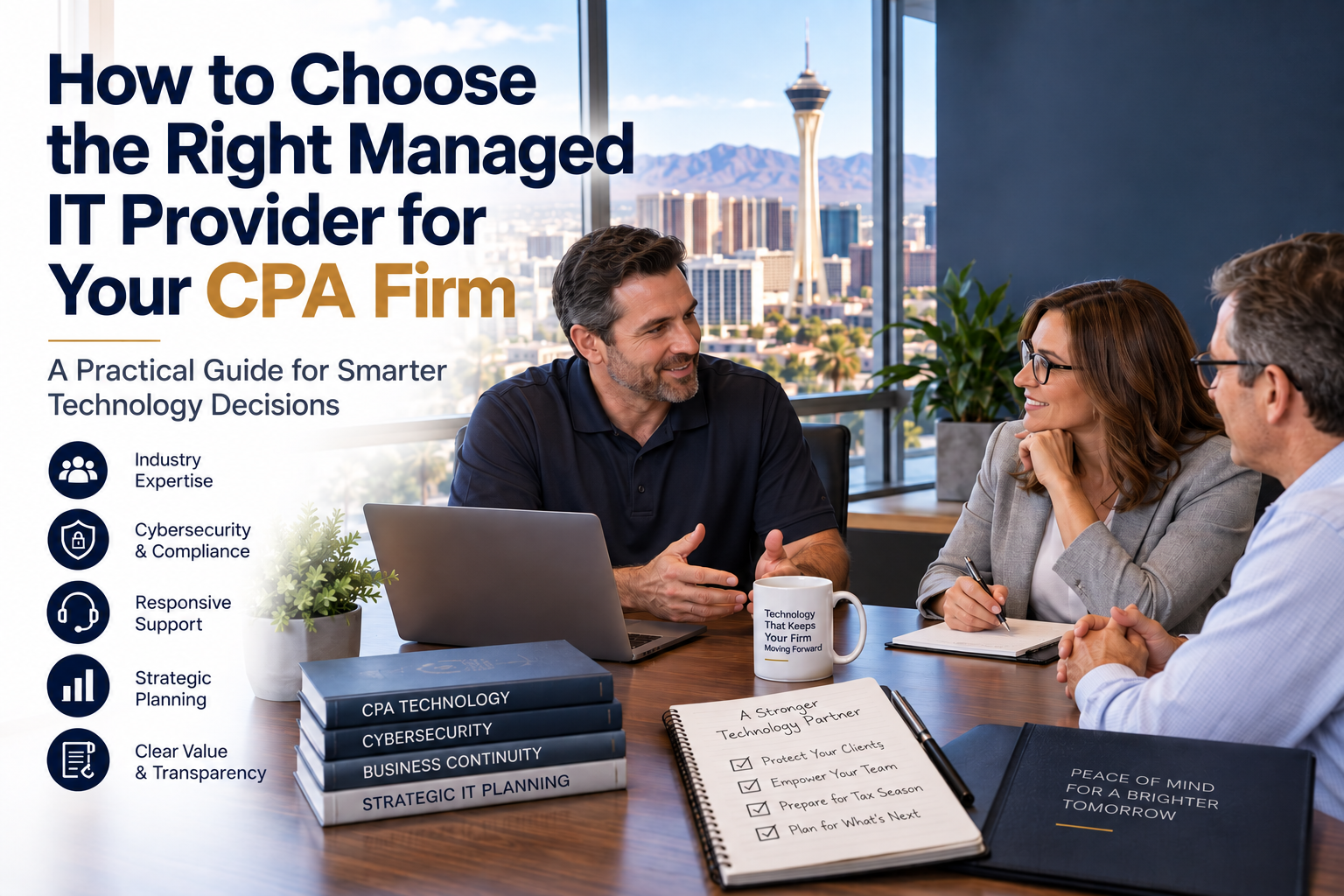
Choosing the right managed IT provider for a CPA firm requires more than comparing monthly prices or counting the services listed on proposals.
A strong technology partner should understand the applications your firm depends on, prepare your environment for tax season, help protect sensitive taxpayer information, provide responsive support, and help leadership plan technology investments over a three- to five-year horizon.
For a 10- to 50-employee CPA firm, the decision can affect everything from employee productivity and cybersecurity to technology budgeting and the firm's ability to serve clients during its busiest months.
The right question isn't simply:
"Who can manage our IT?"
A better question is:
"Who understands our business well enough to help us make better technology decisions?"
That's the standard we recommend using when comparing providers.
Why CPA Firms Should Evaluate IT Providers Differently
CPA firms don't operate like generic small businesses.
During tax season, technology problems that might be inconvenient in July can become serious business disruptions in February, March, or April. Employees depend on access to tax applications, accounting platforms, Microsoft 365, document management systems, client portals, scanners, printers, and other specialized tools.
The information being handled is also highly sensitive.
CPA firms routinely work with taxpayer information, Social Security numbers, financial statements, payroll records, banking information, and other confidential client data. That makes cybersecurity and information protection part of the technology conversation, not a separate issue that should only be discussed after an incident.
Many firms also operate technology environments that are more complicated than outsiders might expect.
A CPA firm's environment may combine:
- Microsoft 365
- Local servers
- Cloud services
- Hosted desktops
- Tax preparation applications
- Accounting software
- Document management
- Client portals
- Remote access
- Multifunction printers and scanners
- Backup and disaster recovery systems
Some employees may work primarily in cloud applications while others still depend on software running on a local server or hosted Windows environment.
That's why selecting a technology partner based entirely on a generic MSP checklist can miss some of the most important questions.
The ANAX CPA Technology Partner Checklist
We recommend evaluating prospective technology partners across five areas:
- Accounting Environment
- Tax Season Readiness
- Cybersecurity & Regulatory Awareness
- Support & Communication
- Strategy & Financial Planning
A provider doesn't necessarily need to approach every issue exactly the way your current provider does.
In fact, a fresh perspective can be valuable.
What matters is whether they understand your business well enough to explain their recommendations, identify tradeoffs, and help leadership make informed decisions.
Let's start with the first three areas.
-
Do They Understand the Technology Environment of a CPA Firm?
One of the first questions to ask a prospective managed IT provider is deceptively simple:
"How much experience do you have supporting accounting firms?"
The answer matters because CPA technology environments often contain applications and workflows that aren't common in other industries.
A provider should be comfortable discussing how your employees actually work.
That includes understanding questions such as:
- Which applications are essential during tax season?
- Where does your firm's data reside?
- Which applications run locally?
- Which systems are hosted?
- Which services are true SaaS platforms?
- How do employees securely work remotely?
- How are client documents exchanged?
- Which vendors need to be coordinated when something stops working?
- Which systems create the greatest business impact when they're unavailable?
A provider doesn't necessarily need to be the software developer's application support desk. But it should understand the surrounding infrastructure and be willing to coordinate with software vendors when troubleshooting crosses organizational boundaries.
Can They Tell the Difference Between "Cloud" and SaaS?
This is an especially useful question for CPA firms.
A great deal of accounting software is marketed as being available "in the cloud." But cloud can mean very different things.
A true software-as-a-service platform may run directly through a web browser and be managed largely by the software provider.
Another "cloud" offering may essentially be your existing Windows applications running inside a hosted virtual desktop or virtual server.
Both models can be perfectly legitimate.
They simply have different:
- Costs
- Performance characteristics
- Management requirements
- Security considerations
- Vendor dependencies
- Long-term financial implications
This distinction becomes especially important when providers automatically recommend moving every remaining server or application into a hosted environment.
For some CPA firms, that may be exactly the right decision.
For others, it may not be.
A hosted virtual environment carrying recurring per-user fees can become expensive over a five- to seven-year period, particularly when compared with purchasing and maintaining appropriately designed server infrastructure over the same lifecycle.
That doesn't make servers inherently better than hosted infrastructure.
It means the decision deserves analysis.
A technology partner should be able to compare the total cost of ownership, operational requirements, remote-access needs, security considerations, vendor roadmap, and expected useful life of each option.
The answer shouldn't always be "cloud."
And it shouldn't always be "server."
The answer should be:
Which approach makes the most sense for this firm?
Technology Partner Tip
Be cautious when a prospective provider recommends a major infrastructure change before taking the time to understand why your current environment was designed the way it is. Modernization can create substantial value, but replacing technology simply because something newer exists isn't a strategy.
-
How Will They Prepare Your Firm for Tax Season?
CPA firms don't experience technology demand evenly throughout the year.
Busy season changes the equation.
Support volume can increase. Seasonal employees may need accounts and equipment. Tax applications require updates. Remote access becomes more important. Employees may work longer hours, and the business has less tolerance for unexpected downtime.
That's why one of the best questions to ask a prospective provider is:
"What will you do before tax season to make sure we're ready?"
A thoughtful answer should go beyond:
"Call us if something breaks."
A proactive technology partner should be thinking about readiness before the busiest weeks arrive.
Depending on the firm's environment, that could include reviewing:
- Workstation health
- Server health and capacity
- Available storage
- Software updates
- Backup status
- Recovery procedures
- Network performance
- Internet connectivity
- Remote access
- Security controls
- Microsoft 365
- Employee accounts
- Seasonal employee onboarding
- Vendor contacts and escalation procedures
The exact checklist will differ from firm to firm.
The principle doesn't.
Busy season is the wrong time to discover problems that could have been identified beforehand.
Ask About Support During Critical Periods
Firms should also understand how support works when the workload is highest.
Ask:
- What are your normal support hours?
- What happens after hours?
- How are urgent issues escalated?
- Who determines whether an issue is critical?
- Will we interact with the same support organization throughout the relationship?
- Where is the support team located?
- How do you handle problems involving our tax software vendor?
There isn't one universally correct support model.
What matters is understanding the model before an urgent situation occurs.
For a Las Vegas CPA firm, this is also an area where local relationships can matter. A provider capable of combining remote support with local resources can offer additional flexibility when an issue can't reasonably be solved from hundreds or thousands of miles away.
-
Do They Understand Cybersecurity in the Context of a CPA Firm?
Every managed IT provider is likely to tell you that cybersecurity is important.
That isn't enough.
A better question is whether the provider can explain cybersecurity in the context of your firm's information, workflows, risks, and responsibilities.
For CPA firms, that conversation should include areas such as:
- Identity protection
- Multifactor authentication
- Endpoint security
- Email security
- Security awareness training
- Access management
- Vulnerability management
- Backup and recovery
- Incident response
- Employee onboarding and offboarding
- Ongoing security reviews
It should also demonstrate awareness of the environment in which tax professionals operate.
For example, the FTC Safeguards Rule under the Gramm-Leach-Bliley Act and IRS resources such as Publication 4557, Safeguarding Taxpayer Data, provide important context around protecting sensitive financial and taxpayer information.
Other IRS resources, including Publications 5293, 1345, and 5708, may also be relevant depending on the firm's activities and the specific security issue being discussed.
A technology provider shouldn't need to turn every cybersecurity conversation into a compliance seminar.
But it should know these resources exist and understand how practical technology controls fit into the firm's broader information security program.
Be Wary of "Compliance in a Box"
Technology can support compliance efforts.
Technology cannot make every organizational obligation disappear.
If a provider suggests that purchasing its security package automatically makes your CPA firm "compliant," ask more questions.
A comprehensive information security program can involve:
- Technology controls
- Policies
- Risk assessments
- Employee training
- Documentation
- Vendor oversight
- Incident response procedures
- Management responsibilities
- Ongoing review
An MSP can play an important role in many of these areas, but technology is only part of the picture.
Compliance Insight
A technology partner should be able to discuss the FTC Safeguards Rule and relevant IRS security guidance without pretending to be your attorney, auditor, or regulator. The goal is regulatory awareness: understanding how technology decisions support the broader responsibilities of the firm.
Cybersecurity Doesn't Have to Be Bundled Into Everything
Another question worth asking is:
"Which security services are included in the managed IT agreement, and which are separate?"
Don't assume that the provider offering the longest list of bundled products automatically provides the best solution.
Different firms have different risk profiles, requirements, existing investments, and budgets.
At ANAX, cybersecurity is offered as a separate service bundle rather than being automatically included in every managed IT agreement.
That distinction creates transparency.
The client can understand:
- What it is paying for
- Which services are operational IT
- Which services are cybersecurity
- Which protections have been selected
- Where additional investments may be appropriate
This also makes it easier to review the security program over time rather than assuming cybersecurity has been "handled" because several products appeared on an MSP proposal.
Cybersecurity is an ongoing journey, not a product someone installs once.
The First Three Questions Tell You a Lot
Before you start comparing detailed proposals, determine whether a prospective technology partner can answer three fundamental questions:
- Do you understand how our CPA firm actually uses technology?
- How will you help us prepare for our busiest and most critical periods?
- Can you help us manage cybersecurity with an understanding of the environment CPA firms operate in?
If the answers are vague, generic, or dominated by product names, keep asking questions.
A strong technology partner should be able to translate technical recommendations into business language and explain why a recommendation makes sense for your firm.
-
How Will Support and Communication Actually Work?
Almost every managed IT provider promises responsive support.
The more useful question is:
What does "responsive support" actually mean?
Before signing an agreement, understand what happens when one of your employees needs assistance.
Ask prospective providers:
- How do employees request support?
- Who receives those requests?
- Where is the support team located?
- What are the normal support hours?
- How are urgent issues prioritized?
- What happens after hours?
- How are unresolved issues escalated?
- How will you communicate during a major outage?
- When is onsite support available?
- Who is responsible for coordinating with third-party vendors?
These questions become especially important for CPA firms because the business impact of an IT issue can change dramatically throughout the year.
A printer problem may be frustrating during a slower period.
An inaccessible tax application, failed scanner, or authentication problem affecting multiple employees during a filing deadline is a very different situation.
Your provider should understand that distinction.
Where Is Your Support Team Located?
This is a question businesses don't always think to ask.
Many managed IT providers use outsourced or offshore resources for some portion of their help desk, network operations, or technical support.
That business model isn't inherently wrong. Offshore resources can provide scale and extended coverage.
But firms should know who will actually be supporting their employees and managing their technology.
Questions worth asking include:
- Is your help desk operated by your company?
- Are support services outsourced?
- Are any support functions performed offshore?
- Will we regularly work with the same team?
- Where are the engineers who manage our infrastructure located?
- Is local onsite support available when necessary?
The objective isn't to assume one model is automatically superior.
It's to make the service delivery model transparent before you enter the relationship.
At ANAX Business Technology, our team is U.S.-based, and most of our team members live and work in the Las Vegas valley. That allows us to combine responsive local support with long-term technology planning while maintaining direct accountability for the services we provide.
For a Las Vegas CPA firm, that can also be valuable when an issue requires someone to physically visit the office.
Remote support can resolve a tremendous number of technology problems.
Sometimes, however, you need someone in the room.
Communication Matters as Much as Technical Skill
An IT provider can employ talented engineers and still be difficult to work with.
Technology partners also need to communicate effectively with people who aren't technology professionals.
Your managing partner shouldn't need to understand networking terminology to make an informed infrastructure decision.
Your office administrator shouldn't need to translate a technical support ticket.
And your employees shouldn't feel uncomfortable asking for help.
A strong provider should be able to explain:
- What happened
- Why it matters
- What needs to happen next
- What the alternatives are
- What the recommendation will cost
- What happens if the firm chooses not to proceed
This becomes particularly important when discussing major investments.
For example, imagine your firm's server is approaching the end of its useful life.
One provider might say:
"Servers are outdated. Everything needs to move to the cloud."
Another might say:
"Let's compare replacing the server with the hosted alternatives available for your applications. We'll evaluate five- to seven-year costs, remote-access requirements, security, business continuity, vendor roadmaps, and how your employees actually work."
The second conversation gives leadership something useful:
a decision framework.
That's what strategic technology guidance should provide.
-
Can They Help You Plan Three to Five Years Ahead?
The best managed IT relationships aren't measured only by the number of support tickets closed.
They should also help reduce the number of technology surprises leadership encounters.
Ask a prospective provider:
"What will our technology environment need three to five years from now, and how will you help us plan for it?"
Nobody can predict technology perfectly.
But a strategic provider should be able to help you plan around known lifecycle events and likely business changes.
That might include:
- Workstation replacements
- Server lifecycle
- Firewall and network replacements
- Microsoft 365 licensing
- Cybersecurity investments
- Backup and business continuity
- Office expansion
- Hiring
- Acquisitions
- Cloud migrations
- Accounting software changes
- AI initiatives
- Tax-season capacity
This planning should eventually translate into a technology roadmap and budget.
Ask to See the Planning Process
Don't settle for being told that the provider offers "strategic IT consulting."
Ask what that means.
For example:
- How often will we review our technology environment?
- Who participates in those reviews?
- Will you provide a technology roadmap?
- Will upcoming hardware replacements be identified in advance?
- Will you help us estimate project costs?
- How do you prioritize recommendations?
- How do you distinguish something we need now from something we may need later?
- How will our business plans influence your recommendations?
These questions help distinguish genuine strategic planning from an annual meeting that consists primarily of selling new products.
Technology Partner Tip
A useful technology roadmap should tell you not only what to buy, but also what can wait. Prioritization is one of the most valuable services a technology partner can provide.
Look for Financial Awareness, Not Just Technical Knowledge
Technology recommendations have financial consequences.
That's particularly important for CPA firms evaluating infrastructure.
As we've discussed elsewhere in this series, many accounting applications still rely on traditional Windows architecture. Some vendors offer hosted versions that provide remote accessibility but are effectively virtual desktops or hosted servers rather than true SaaS platforms.
A provider recommending a hosted environment should be able to explain its economics.
Likewise, a provider recommending another physical or virtual server should be able to explain why that investment still makes sense.
Consider comparing:
- Initial implementation costs
- Monthly hosting fees
- Software licensing
- Server acquisition costs
- Expected five- to seven-year lifecycle
- Maintenance
- Backup and recovery
- Internet requirements
- Remote-access requirements
- Performance
- Scalability
- Vendor support
- Migration costs
- Exit costs
A recurring monthly payment may appear easier to budget than a capital investment, but that doesn't automatically make it less expensive.
Conversely, a lower total cost doesn't automatically make an on-premises system the better operational choice.
Total cost of ownership should inform the decision—not make the decision by itself.
A good technology partner helps leadership understand the tradeoffs.
Does the Provider Understand Your Technology Budget?
A CPA firm shouldn't discover in December that it needs a major server replacement in January.
Lifecycle planning should identify significant investments well in advance whenever reasonably possible.
A mature planning process should account for four broad categories:
Recurring Services + Technology Lifecycle + Projects + Contingency = Annual Technology Budget
That includes predictable recurring expenses such as managed IT and Microsoft 365, but also less frequent investments such as:
- Server replacements
- Workstations
- Firewalls
- Network equipment
- Business continuity improvements
- Security projects
- Office moves
- Major software migrations
For example, a 25-employee firm replacing workstations on a five-year lifecycle should expect to replace approximately five computers per year.
That expense shouldn't be surprising.
Neither should a server approaching year six of a planned five- to seven-year lifecycle.
Technology planning turns those future expenses into conversations leadership can prepare for.
Don't Compare Managed IT Proposals by Price Alone
Once firms receive several proposals, it's tempting to put the monthly prices next to each other and select the one that appears to offer the most services for the least money.
That can be misleading.
Consider two hypothetical proposals.
Provider A
$5,000 per month
Includes:
- Help desk
- Monitoring
- Microsoft 365 administration
- Proactive maintenance
- Vendor coordination
- Strategic technology reviews
Cybersecurity is separately defined and priced.
Provider B
$4,200 per month
Advertises:
- "Unlimited IT"
- "Complete cybersecurity"
- "24/7 monitoring"
- "Cloud management"
At first glance, Provider B appears to offer more for $800 less per month.
But the proposal doesn't tell you:
- Which cybersecurity controls are actually included
- Whether projects cost extra
- Whether after-hours support is included
- Who operates the help desk
- Whether support is offshore
- What "cloud management" includes
- Whether strategic planning is provided
- How onsite support is billed
- What happens when the firm exceeds the provider's assumptions
That doesn't mean Provider B is necessarily the wrong choice.
It means you don't yet have enough information to compare the proposals.
Normalize the Proposals Before Comparing Them
Create a simple comparison covering:
| Evaluation Area | Provider A | Provider B |
| Proactive IT management | Included? | Included? |
| Reactive support | Model/cost | Model/cost |
| Microsoft 365 management | Scope | Scope |
| Cybersecurity | Exact controls | Exact controls |
| Backup/BCDR | Scope | Scope |
| Projects | Included/separate | Included/separate |
| After-hours support | Terms | Terms |
| Onsite support | Terms | Terms |
| Vendor coordination | Included? | Included? |
| Strategic planning | Frequency/scope | Frequency/scope |
| Support team location | U.S./offshore/local | U.S./offshore/local |
| Contract term | Terms | Terms |
Only after normalizing the proposals can you make a meaningful financial comparison.
Understand the Service Model You're Buying
Another common mistake is assuming every managed services agreement works the same way.
They don't.
At ANAX, for example, we offer three service models because different organizations prefer different approaches to support and budgeting.
Comprehensive Support Agreement (CSA)
A Comprehensive Support Agreement combines proactive technology management with reactive support under a predictable managed services structure.
This model may work well for firms that want broad day-to-day support incorporated into their recurring agreement.
Block Labor & Services Agreement (BSA)
The Block Labor & Services Agreement is ANAX's most popular model.
Under a BSA, proactive maintenance and management are provided while the client purchases a block of labor hours for reactive support.
This provides visibility into reactive support usage while maintaining ongoing proactive management.
For some firms, that creates an effective balance between predictable services and budget flexibility.
Essential Services Agreement (ESA)
An Essential Services Agreement focuses primarily on proactive monitoring and maintenance, with reactive support billed separately when required.
This can be appropriate for organizations with relatively low support requirements or internal resources capable of handling some day-to-day needs.
There Is No Universally "Best" Agreement
One model isn't automatically better than another.
A firm with frequent support needs may value the predictability of a comprehensive agreement.
Another firm may prefer the visibility and flexibility of block hours.
Another may need primarily proactive management.
The important question is:
Does the agreement match how your firm actually uses IT support?
This is another reason to be cautious about evaluating MSPs entirely on advertised per-user pricing.
The structure behind that number matters.
Ask What's Not Included
This may be the most valuable question you ask during the sales process:
"What isn't included in this agreement?"
Every service agreement has boundaries.
Understanding them isn't a negative.
It's good business.
Ask specifically about:
- Projects
- After-hours work
- Onsite support
- New computer installations
- Office moves
- Cabling
- Major software upgrades
- Server replacements
- Cybersecurity
- Backup and disaster recovery
- Microsoft licensing
- Hardware
- Third-party software
- Incident response
A provider that clearly explains exclusions is giving you information you can budget around.
Ambiguity is much harder to budget for.
Budget Tip
Don't ask only for the monthly managed IT price. Ask for an estimate of your total expected annual technology spend, including recurring services, cybersecurity, licensing, lifecycle replacements, and known projects. That provides a much more useful basis for comparing providers.
The Relationship Should Get More Valuable Over Time
During the first few months of a new managed IT relationship, your provider will learn a great deal about your environment.
Over time, it should also learn more about:
- Your employees
- Your workflows
- Your accounting applications
- Your busiest periods
- Your business priorities
- Your recurring frustrations
- Your growth plans
- Your risk tolerance
That institutional knowledge should make the relationship more valuable—not more complacent.
A strong technology partner should gradually become better at anticipating what your firm needs.
By the time you're discussing next year's technology budget, the conversation shouldn't begin with:
"Tell us what equipment you have."
It should begin with:
"Here's what we know is coming, and here are the decisions we should start planning for now."
That's the difference between maintaining technology and helping manage a technology strategy.
15 Questions to Ask Before Choosing a Managed IT Provider
You don't need to become an IT expert to evaluate an IT company.
You simply need to ask good questions.
Here are 15 we recommend CPA firms use during the evaluation process.
Experience With Your Firm
- How much experience do you have supporting CPA and accounting firms?
Ask for specifics rather than accepting a simple "yes."
- How do you support specialized tax and accounting applications?
The MSP doesn't necessarily need to provide application-level support, but it should be comfortable troubleshooting the underlying technology and coordinating with your software vendors.
- How would you prepare our technology environment for tax season?
Listen for a proactive process involving system health, backups, security, capacity, software updates, employee accounts, vendor coordination, and other readiness activities.
Support
- Where is your support team located?
Determine whether support is local, U.S.-based, offshore, outsourced, or some combination.
- What happens when an issue can't be resolved remotely?
Understand how onsite support works and whether additional charges apply.
- How are urgent issues escalated?
Ask the provider to explain what would happen if multiple employees couldn't access a critical tax application during a filing deadline.
Cybersecurity
- Which cybersecurity services are included, and which are separate?
Ask for specific controls rather than accepting terms such as "complete cybersecurity."
- How familiar are you with the FTC Safeguards Rule and IRS security guidance for tax professionals?
You aren't necessarily looking for the MSP to serve as your compliance consultant.
You are determining whether the provider understands the environment in which your firm operates.
A provider supporting CPA firms should at least be familiar with resources such as IRS Publication 4557 and understand how technology controls can support a broader information security program.
- How do you evaluate whether our cybersecurity program needs to change?
Security isn't something that should be configured once and forgotten.
Look for ongoing reviews, risk discussions, employee education, vulnerability management, and planning.
Strategy
- How often will we review our technology strategy?
Ask who attends those meetings and what deliverables you'll receive.
- Will you provide a three- to five-year technology roadmap?
Major lifecycle events shouldn't arrive as surprises.
- How do you help clients build annual technology budgets?
A strategic provider should be able to discuss recurring services, lifecycle replacements, projects, and contingency planning.
Financial & Contractual
- What isn't included in your agreement?
This can be more revealing than asking what is included.
- How are projects, after-hours support, and onsite work billed?
Understand these costs before comparing proposals.
- If you recommend replacing a server with a hosted environment, how will you compare the total cost of ownership?
For CPA firms, this is an especially useful test.
A thoughtful provider should be willing to compare at least:
- Upfront investment
- Recurring hosting fees
- Five- to seven-year costs
- Software licensing
- Backup and recovery
- Performance
- Remote access
- Security
- Vendor roadmap
- Migration requirements
If the only explanation is "everything belongs in the cloud," ask for more analysis.
Red Flags to Watch For
No single issue automatically makes a provider the wrong choice.
However, several warning signs should lead to additional questions.
Red Flag #1: They Recommend Solutions Before Discovery
If a provider knows you need a cloud migration, new firewall, new server, or completely different security platform before thoroughly understanding your environment, ask how that conclusion was reached.
Recommendations should follow discovery.
Red Flag #2: Everything Is "Unlimited"
Unlimited support sounds appealing.
But unlimited rarely means literally unlimited.
Ask about:
- Projects
- After-hours work
- Onsite visits
- New installations
- Office moves
- Major upgrades
- Third-party vendor issues
There's nothing wrong with contractual boundaries.
The problem is discovering them after signing.
Red Flag #3: They Can't Clearly Explain Cybersecurity
Be cautious if security discussions consist primarily of product names.
A provider should be able to explain what risks each control addresses and why the recommendation matters to your firm.
Likewise, be skeptical of claims that buying a particular bundle automatically makes your organization compliant.
Red Flag #4: "Cloud" Is the Answer to Every Question
Cloud services have transformed business technology and can provide tremendous value.
But not every application used by CPA firms is a true SaaS platform, and not every hosted environment provides a lower long-term cost.
Your provider should evaluate the business case rather than promote a predetermined architecture.
Red Flag #5: There's No Long-Term Planning Process
If the relationship consists entirely of submitting support tickets, something is missing.
A managed IT provider should help identify future technology investments before they become emergencies.
Red Flag #6: You Don't Know Who Will Actually Support You
If the sales team is local but the support model is unclear, ask questions.
Find out whether support is:
- Internal
- Outsourced
- Offshore
- U.S.-based
- Local
- A combination of these
There are legitimate reasons providers use different models.
You should simply know what you're buying.
A Real-World Comparison: Two Providers, Two Very Different Proposals
Consider a hypothetical 25-employee Las Vegas CPA firm evaluating two managed IT providers.
The firm uses Microsoft 365, several tax and accounting applications, a local server, a document management platform, and secure remote access.
Its server is approximately six years old.
Provider A
Provider A proposes:
- Managed IT services
- Proactive monitoring and maintenance
- Microsoft 365 administration
- Vendor coordination
- Quarterly technology reviews
- Separate cybersecurity services
- Local onsite support when necessary
During discovery, Provider A identifies the aging server but doesn't immediately recommend a replacement.
Instead, it proposes comparing:
- A new server with a planned five- to seven-year lifecycle
- The hosting options available for the firm's accounting applications
- A hybrid approach if appropriate
The provider then models recurring hosting expenses against the expected server lifecycle and discusses performance, security, remote access, backup, business continuity, and the software vendors' future roadmaps.
Provider B
Provider B proposes:
- "Unlimited IT"
- "Complete security"
- "24/7 monitoring"
- A migration to its preferred hosted environment
Provider B recommends eliminating the server immediately because the cloud is "more modern."
The proposal has an attractive monthly price, but it isn't clear:
- Which security controls are included
- Who operates the help desk
- Whether projects are included
- How onsite support works
- What the hosted environment will cost over seven years
- What happens if the firm eventually wants to leave that hosting platform
Which Provider Is Better?
There isn't enough information to automatically declare Provider A or Provider B the winner.
And that's the point.
The firm should investigate the unanswered questions before making a decision.
Provider B's hosted solution could ultimately be the better choice.
Provider A's server replacement could ultimately provide better long-term value.
The quality of the decision depends on the analysis behind it.
A good technology partner shouldn't be afraid to show you the tradeoffs.
CPA Firm MSP Evaluation Scorecard
Use this scorecard when comparing prospective providers.
Score each category from 1 to 5:
- 1 = Poor
- 2 = Below Expectations
- 3 = Acceptable
- 4 = Strong
- 5 = Excellent
| Evaluation Category | Weight | Provider Score |
| CPA/accounting industry experience | 10% | ___ / 5 |
| Understanding of accounting applications | 10% | ___ / 5 |
| Tax season readiness process | 10% | ___ / 5 |
| Cybersecurity capabilities | 10% | ___ / 5 |
| FTC/IRS security awareness | 5% | ___ / 5 |
| Help desk/support model | 10% | ___ / 5 |
| Local/onsite capabilities | 5% | ___ / 5 |
| Communication & escalation | 10% | ___ / 5 |
| Strategic technology planning | 10% | ___ / 5 |
| Budget & lifecycle planning | 10% | ___ / 5 |
| Contract/pricing transparency | 5% | ___ / 5 |
| Vendor coordination | 5% | ___ / 5 |
| Total | 100% | _____ |
The weighting isn't universal.
For example, a firm with several offices may assign more weight to onsite capabilities. A firm operating almost entirely remotely may assign less.
The value of the exercise is forcing leadership to define what matters before comparing prices.
Technology Partner Tip
Have two or three members of your leadership team score each provider independently before discussing the results. Differences in scores can reveal concerns or priorities that might otherwise go unspoken.
Don't Forget the Human Fit
There is one category that's difficult to put into a spreadsheet.
Do you trust these people?
A managed IT provider may have administrative access to some of your firm's most important technology systems and could become deeply involved in your operations.
You'll probably interact with the provider when:
- An employee can't work
- A system fails
- You're concerned about a security incident
- You're making a significant investment
- You're preparing for tax season
- You're opening a new office
- Something unexpected happens
Technical qualifications matter.
So do communication, accountability, judgment, and trust.
The lowest bidder isn't necessarily the wrong provider.
The highest bidder isn't necessarily the best provider.
And the provider with the longest feature list isn't necessarily delivering the greatest value.
The goal is to find the organization whose people, service model, technical capabilities, and strategic approach fit your firm.
Key Takeaways
When choosing a managed IT provider for your CPA firm, remember these seven principles:
- Look for CPA-specific understanding. Your provider should understand accounting applications, tax-season pressures, and the realities of hybrid technology environments.
- Evaluate the support model. Know who will support your employees, where they're located, and how urgent issues are escalated.
- Expect cybersecurity awareness. Your provider should understand the FTC Safeguards Rule and relevant IRS security guidance without claiming that technology alone creates compliance.
- Demand transparency. Understand what's included, what's excluded, and how additional work is billed.
- Expect long-term planning. Technology lifecycle, budgeting, cybersecurity, and major projects should be discussed before they become urgent.
- Evaluate tradeoffs rather than trends. Server, hosted, cloud, and SaaS decisions should be based on business requirements and total cost of ownership.
- Choose people you trust. Technology partnerships work best when communication and accountability are as strong as technical skills.
Ready to Find the Right Technology Partner for Your CPA Firm?
Choosing a managed IT provider is about more than finding someone to fix computers. The right relationship should give your firm responsive support today while helping leadership plan for the technology, security, and business challenges ahead.
At ANAX Business Technology, we take a consultative approach. We work with CPA firms to understand how employees use technology, identify operational and security priorities, evaluate competing options, and develop practical strategies that support long-term business objectives.
Our U.S.-based team members live and work in the Las Vegas valley, allowing us to combine responsive local support with long-term technology planning. We believe the best technology partnerships are built on accessibility, accountability, transparency, and an understanding of the businesses we serve.
Whether you're evaluating your first managed IT provider or wondering whether your current relationship is still the right fit, we're happy to help you think through the decision.
Schedule your Initial Consultation with ANAX Business Technology to discuss your firm's technology environment, priorities, and what you should expect from a long-term technology partner.