
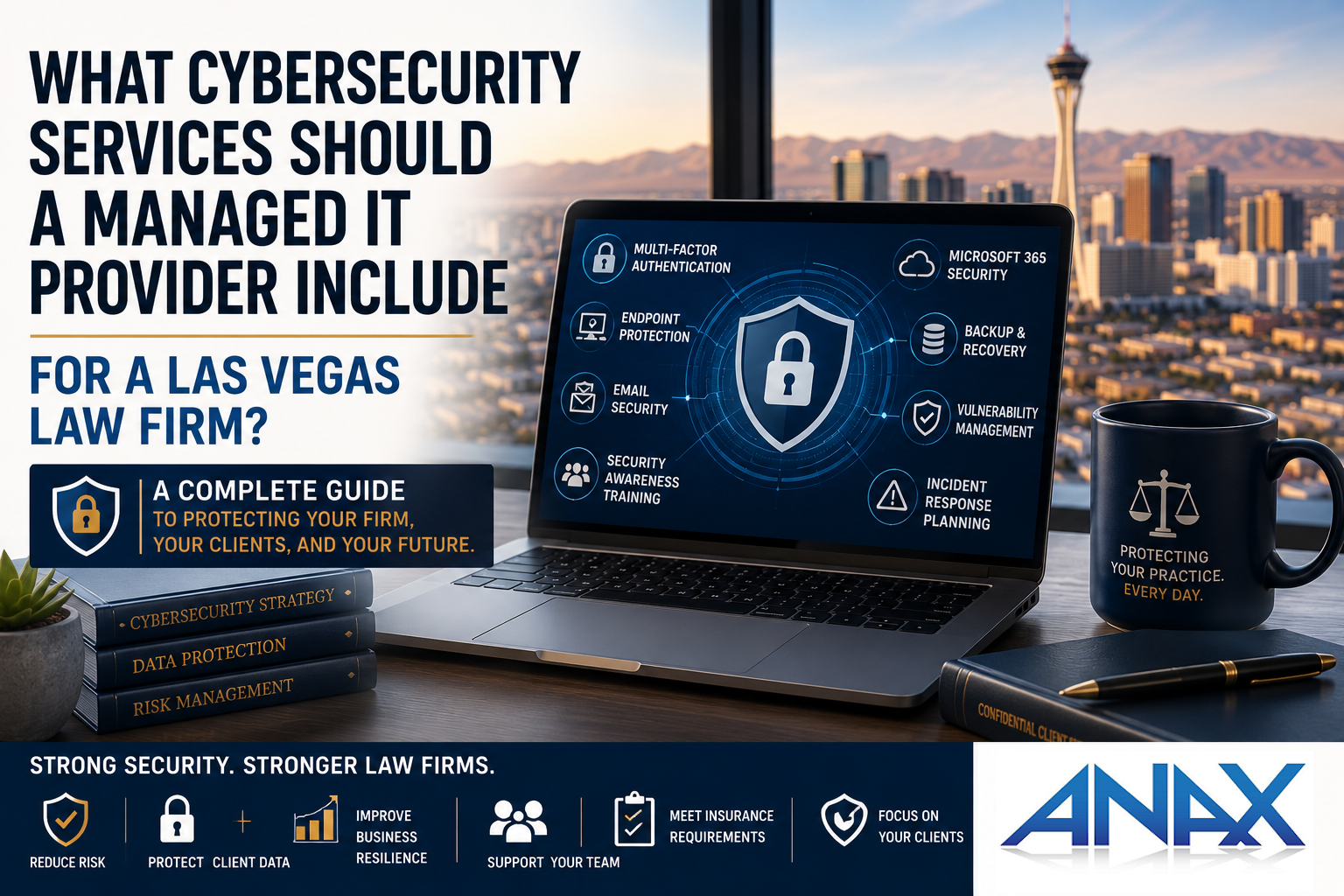
Cybersecurity is no longer an optional service for law firms. Every day, attorneys and staff rely on technology to access confidential client information, communicate securely, manage documents, and collaborate with colleagues. Protecting those systems requires far more than antivirus software or a strong password.
The right managed IT provider should deliver a layered cybersecurity strategy that reduces risk, supports compliance requirements, and helps your firm respond quickly if a security incident occurs.
If you're evaluating managed IT providers in Las Vegas, this guide explains the cybersecurity services you should expect to be included and the questions you should ask before signing an agreement.
Quick Answer
A modern managed IT provider should offer far more than basic IT support.
At a minimum, law firms should expect a cybersecurity program that includes:
- Multi-Factor Authentication (MFA)
- Endpoint Detection and Response (EDR)
- Microsoft 365 security management
- Email security and phishing protection
- Backup monitoring and recovery testing
- Security awareness training
- Vulnerability management
- Incident response planning
- Ongoing security reviews
These services work together to create multiple layers of protection rather than relying on any single security tool.
Why Cybersecurity Matters More Than Ever for Law Firms
Every law firm stores information that clients expect will remain confidential.
Contracts.
Financial records.
Litigation documents.
Personally identifiable information.
Email communications.
Intellectual property.
Protecting that information isn't simply good business practice. It's essential to maintaining client trust and supporting the reputation you've worked hard to build.
At the same time, today's technology environments have become significantly more complex.
Employees work remotely.
Files are stored in Microsoft 365 and cloud applications.
Attorneys access documents from laptops, tablets, and smartphones.
Clients exchange sensitive information electronically.
Every new device and cloud service creates another point that must be secured.
That's why cybersecurity is no longer a product you purchase once.
It's an ongoing process of monitoring, improving, educating, and adapting as technology and threats continue to evolve.
Your managed IT provider should be leading that effort.
A Layered Approach to Cybersecurity
One of the biggest misconceptions about cybersecurity is that a single product can protect an entire business.
It can't.
Effective cybersecurity works because multiple security measures overlap and support one another.
Think of it like securing a law office.
You wouldn't rely solely on a front door lock.
You'd also have:
- Alarm systems
- Locked filing cabinets
- Security cameras
- Access controls
- Employee procedures
- Visitor policies
Technology security follows the same philosophy.
If one layer fails, another helps reduce the risk.
That's why experienced managed IT providers build security programs using multiple technologies and processes working together.
- Multi-Factor Authentication (MFA)
If there's one cybersecurity feature every law firm should require, it's Multi-Factor Authentication.
Passwords alone are no longer enough.
Even strong passwords can be stolen through phishing attacks, reused across multiple websites, or exposed in data breaches outside your organization.
Multi-Factor Authentication adds another layer of verification before someone can access an account.
In addition to entering a password, users may also verify their identity through:
- An authentication app
- A push notification
- A hardware security key
- A one-time verification code
This additional step dramatically reduces the likelihood that stolen credentials alone can be used to access your systems.
Today, MFA should be enabled for:
- Microsoft 365
- VPN access
- Cloud applications
- Administrative accounts
- Financial systems
If a managed IT provider doesn't prioritize Multi-Factor Authentication, that should raise serious questions about their overall cybersecurity strategy.
- Endpoint Detection and Response (EDR)
Traditional antivirus software looks for known threats.
Modern cyberattacks move much faster.
Endpoint Detection and Response (EDR) continuously monitors computers and servers for suspicious behavior rather than simply matching files against a database of known viruses.
An effective EDR platform can:
- Detect ransomware activity
- Identify unusual user behavior
- Monitor unauthorized software
- Isolate compromised devices
- Alert security teams in real time
Rather than waiting until malware has already caused damage, EDR helps identify threats early and reduce their impact.
For law firms, this added visibility is especially valuable because confidential client information often resides on employee workstations.
- Microsoft 365 Security Management
Microsoft 365 has become the foundation of daily operations for many law firms.
Email.
Calendars.
Teams.
SharePoint.
OneDrive.
Document collaboration.
Because Microsoft 365 is so widely used, it's also one of the most frequently targeted platforms for cybercriminals.
A managed IT provider shouldn't simply create user accounts and walk away.
They should continuously monitor and improve the security of your Microsoft 365 environment.
This often includes:
- Conditional Access policies
- Multi-Factor Authentication
- Identity protection
- Secure sharing policies
- Email authentication
- Data Loss Prevention (DLP) where appropriate
- Administrative access controls
- Ongoing security reviews
Microsoft continually introduces new security capabilities.
A proactive technology partner helps ensure your organization benefits from those improvements instead of leaving valuable protections unused.
- Email Security and Phishing Protection
Despite advances in cybersecurity, email remains one of the most common ways attackers attempt to gain access to businesses.
Phishing emails are designed to look legitimate.
They may appear to come from:
- Clients
- Banks
- Microsoft
- Vendors
- Coworkers
Their goal is often to trick someone into:
- Clicking a malicious link
- Opening an infected attachment
- Sharing login credentials
- Approving fraudulent payments
A managed IT provider should implement multiple layers of email security, including:
- Spam filtering
- Malware scanning
- Link protection
- Attachment analysis
- Domain impersonation protection
- Business email compromise detection
Technology plays an important role, but employee awareness is equally important.
We'll cover that next.
- Security Awareness Training
Even with advanced security tools in place, your employees remain one of the most important parts of your cybersecurity strategy.
Most successful cyberattacks don't begin by exploiting software.
They begin by exploiting people.
Attackers know it's often easier to trick someone into clicking a malicious link than it is to break through multiple layers of technical security.
That's why ongoing employee education should be part of every managed cybersecurity program.
Effective security awareness training helps employees recognize:
- Phishing emails
- Business email compromise (BEC)
- Social engineering attempts
- Suspicious links and attachments
- Password security best practices
- Safe browsing habits
- Secure handling of confidential client information
Training shouldn't be a one-time event during onboarding.
Cyber threats continue to evolve, and employee education should evolve with them.
Many managed IT providers also include simulated phishing campaigns that help employees practice identifying suspicious emails in a safe environment. These exercises provide valuable insights into where additional training may be needed without exposing your firm to unnecessary risk.
Cybersecurity isn't just an IT responsibility.
It's a shared responsibility across the entire organization.
- Vulnerability Management
No technology environment is perfect.
New software vulnerabilities are discovered every week.
Hardware ages.
Applications are updated.
Security recommendations change.
An effective managed IT provider doesn't wait for something to break before taking action.
Instead, they continuously evaluate your environment for weaknesses that could increase risk.
A vulnerability management program typically includes:
- Regular vulnerability scans
- Operating system updates
- Third-party application patching
- Firmware updates
- Security configuration reviews
- Prioritization of critical vulnerabilities
- Remediation planning
Not every vulnerability requires immediate action.
Part of your technology partner's role is helping you understand which issues pose the greatest risk so they can be addressed in a logical, prioritized manner.
- Backup Monitoring and Recovery Testing
Backups are one of the most important components of any cybersecurity strategy.
Unfortunately, many organizations assume that because backups exist, they'll work when they're needed.
That's not always the case.
A managed IT provider should do more than simply confirm that backups are running.
They should regularly verify that your data can actually be restored.
For law firms, that means protecting information such as:
- Client documents
- Case files
- Microsoft 365 data
- Financial records
- Practice management systems
Ask prospective providers questions such as:
- How often are backups monitored?
- How frequently are backup failures investigated?
- How often are recovery tests performed?
- How long would it take to restore our systems after an incident?
- Which systems are backed up?
- Are cloud services like Microsoft 365 included?
The ability to recover quickly can make a significant difference after a ransomware attack, hardware failure, or accidental deletion.
A backup isn't valuable until you've confirmed it can successfully restore your data.
- Incident Response Planning
Even organizations with strong cybersecurity programs should prepare for the possibility of a security incident.
The goal isn't to create fear.
It's to create confidence.
An incident response plan outlines how your organization will respond if a cybersecurity event occurs.
Rather than making important decisions during a stressful situation, your team already has a documented process to follow.
An incident response plan typically addresses:
- Who should be notified
- How affected systems are isolated
- Communication procedures
- Recovery priorities
- Regulatory or legal considerations
- Documentation requirements
- Lessons learned after the incident
Ask your managed IT provider whether they have documented procedures for responding to cybersecurity events.
Experience matters.
A provider that has handled real-world incidents can often guide clients through recovery more efficiently while minimizing business disruption.
- Cyber Insurance Readiness
Cyber insurance has become increasingly common among law firms and professional services organizations.
Many insurance carriers now require businesses to demonstrate that certain cybersecurity controls are already in place before issuing or renewing coverage.
Your managed IT provider should be familiar with these requirements and help your firm prepare.
Common requirements may include:
- Multi-Factor Authentication
- Endpoint Detection and Response
- Secure backups
- Email security
- Security awareness training
- Administrative account protections
- Documented security policies
While every insurance policy is different, working with a technology partner who understands these expectations can simplify the renewal process and help identify gaps before they become a problem.
- Ongoing Security Reviews
Cybersecurity isn't something you implement once and forget.
Technology changes.
Your business changes.
Threats change.
Your cybersecurity strategy should change as well.
That's why ongoing security reviews are an important part of a mature managed IT relationship.
During these reviews, your technology partner should discuss topics such as:
- New cybersecurity risks
- Security improvements already completed
- Recommended next steps
- Technology lifecycle planning
- Compliance considerations
- Business growth
- Upcoming technology projects
These conversations help ensure your cybersecurity strategy continues to support your firm's goals rather than simply reacting to individual support requests.
The most valuable managed IT providers don't just fix technology problems.
They help clients make informed technology decisions before problems arise.
The ANAX Cybersecurity Framework
As you evaluate managed IT providers, remember that effective cybersecurity is built on multiple layers working together.
At ANAX Business Technology, we think about managed cybersecurity as many connected layers rather than a single product or service.
The ANAX Cybersecurity Framework
✓ Identity Protection (Multi-Factor Authentication)
✓ Endpoint Protection (EDR)
✓ Microsoft 365 Security
✓ Email Security
✓ Security Awareness Training
✓ Vulnerability Management
✓ Backup & Recovery
✓ Incident Response Planning
✓ Ongoing Security Reviews
If a proposal focuses primarily on antivirus software while overlooking these other areas, it may not provide the comprehensive protection your law firm needs.
Cybersecurity works best when every layer supports the others.
No single tool can eliminate every risk, but a well-designed strategy significantly improves your firm's ability to prevent, detect, respond to, and recover from security incidents.
Questions to Ask Your Managed IT Provider About Cybersecurity
Whether you're evaluating a new provider or reviewing your current IT partnership, don't hesitate to ask detailed questions about your cybersecurity program.
A knowledgeable technology partner should be able to answer these questions clearly and confidently.
Identity & Access
- Is Multi-Factor Authentication enabled for all users?
- How do you protect administrative accounts?
- How often do you review user access permissions?
- What happens when an employee leaves the firm?
Endpoint Security
- Which Endpoint Detection and Response (EDR) platform do you use?
- Who monitors security alerts?
- What happens if suspicious activity is detected?
- How quickly are threats investigated?
Microsoft 365
- How is our Microsoft 365 environment monitored?
- Are Conditional Access policies configured?
- How do you secure SharePoint and OneDrive?
- Do you regularly review security recommendations from Microsoft?
Email Security
- What phishing protection is included?
- How are malicious attachments handled?
- How do you protect against business email compromise?
- Can you detect domain impersonation?
Backups
- Which systems are backed up?
- How often are backups monitored?
- How frequently do you test restoring data?
- How long would recovery typically take?
Employee Training
- Do you provide ongoing cybersecurity awareness training?
- Are phishing simulations included?
- How often is training updated?
Strategic Planning
- How often do we review our cybersecurity strategy?
- How do you prioritize improvements?
- Can you help us meet cyber insurance requirements?
- How do you stay current with evolving threats?
If a provider struggles to answer these questions or provides vague responses, it may be worth taking a closer look at whether your firm's cybersecurity program is meeting today's expectations.
Signs Your Current Cybersecurity Strategy May Need Improvement
Technology changes quickly.
Even organizations with a managed IT provider should periodically evaluate whether their cybersecurity program continues to meet their needs.
Some signs that it may be time for a conversation include:
- Security is only discussed after a problem occurs.
- You aren't sure what's included in your monthly agreement.
- Employees have never participated in security awareness training.
- Backup recovery has never been tested.
- Multi-Factor Authentication isn't enabled across all critical systems.
- Your IT provider rarely discusses cybersecurity during business reviews.
- You don't know whether your Microsoft 365 environment is regularly evaluated.
- Your cyber insurance renewal requires information your IT provider can't easily provide.
None of these issues necessarily mean your provider isn't doing a good job.
However, they may indicate opportunities to strengthen your firm's overall security posture.
Cybersecurity Is a Journey, Not a Destination
One of the biggest misconceptions about cybersecurity is that it has a finish line.
It doesn't.
New technologies emerge.
Software changes.
Businesses grow.
Cybercriminals continually develop new techniques.
The goal isn't to eliminate every possible risk.
The goal is to continually reduce risk through thoughtful planning, layered security, employee education, and ongoing improvement.
That's why the best managed IT providers view cybersecurity as a long-term partnership rather than a one-time project.
Why Las Vegas Law Firms Choose ANAX Business Technology
At ANAX Business Technology, we believe protecting your firm's technology requires more than installing security software.
It requires proactive planning, continuous monitoring, employee education, and regular conversations about how technology supports your business objectives.
The majority of our U.S.-based team live and work in the Las Vegas valley, allowing us to build lasting relationships with local businesses while providing responsive support when it's needed.
Our goal is simple.
Help law firms operate securely, confidently, and efficiently so they can stay focused on serving their clients.
Ready to Strengthen Your Firm's Cybersecurity?
If you're unsure whether your current cybersecurity strategy provides the protection your law firm needs, we're happy to help.
We'll review your current environment, discuss your business goals, answer your questions, and explain how a layered cybersecurity strategy can support your firm today and as it grows in the future.
Schedule a consultation with ANAX Business Technology:
Final Thoughts
Choosing a managed IT provider isn't just about finding someone to fix technical problems.
It's about finding a trusted technology partner that can help protect your business, support your employees, and guide your firm through an increasingly complex technology landscape.
As you evaluate your options, remember these key principles:
- Cybersecurity should be proactive, not reactive.
- Multiple layers of protection are stronger than any single product.
- Employee education is just as important as technology.
- Regular reviews help keep your strategy aligned with your business.
- The right technology partner helps you plan for the future, not just respond to today's issues.
The best cybersecurity strategy isn't built around fear.
It's built around preparation, partnership, and continuous improvement.