
Every law firm depends on technology.
Attorneys need access to client files.
Staff rely on Microsoft 365 for email and collaboration.
Practice management software must remain available throughout the day.
When technology works, it's easy to take it for granted.
But what happens when it doesn't?
A cyberattack, hardware failure, internet outage, power disruption, or even an accidental file deletion can interrupt your firm's ability to serve clients.
That's why every law firm should have a plan.
Two terms you'll often hear are Business Continuity and Disaster Recovery.
Although they're closely related, they are not the same thing.
Understanding the difference can help your firm prepare for unexpected events while minimizing downtime and protecting client data.
Quick Answer
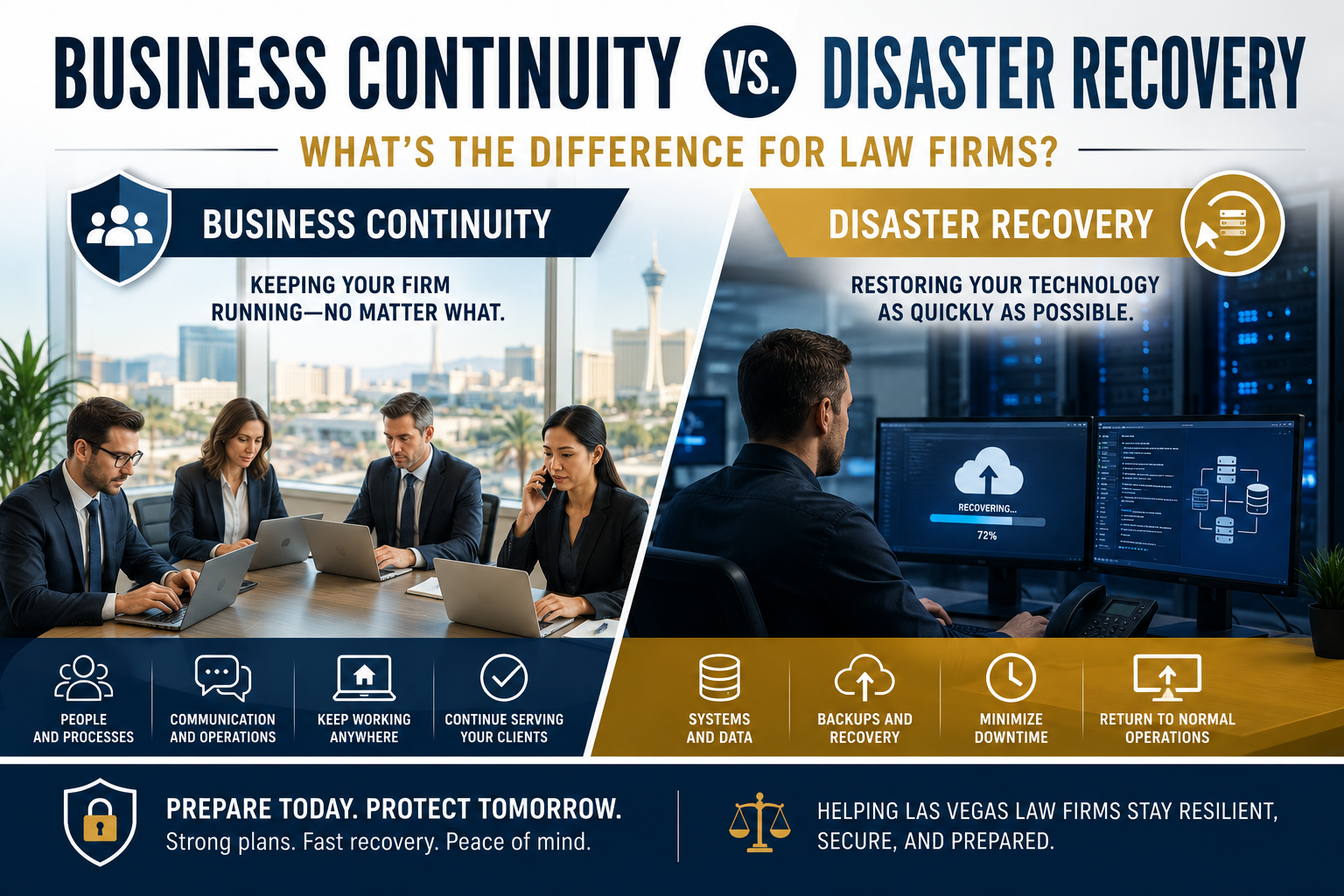
Business Continuity is your firm's overall plan for continuing to operate during and after a disruption.
Disaster Recovery focuses specifically on restoring your technology, systems, and data after an incident.
Think of it this way:
- Business Continuity asks, "How do we keep serving our clients?"
- Disaster Recovery asks, "How do we restore our technology?"
A comprehensive technology strategy requires both.
One keeps your business running.
The other gets your systems back online as quickly as possible.
Why Every Law Firm Needs Both
Unexpected disruptions happen more often than many business owners realize.
Fortunately, not every disruption is a major disaster.
Some examples include:
- An internet outage
- A failed server
- A ransomware attack
- An employee accidentally deleting important files
- A Microsoft 365 outage
- A stolen laptop
- A power failure
- Flooding or fire affecting your office
Each situation creates different challenges.
Some affect your technology.
Others affect your ability to serve clients.
Some affect both.
Having a documented plan allows your team to respond confidently instead of making critical decisions under pressure.
Preparation doesn't eliminate every problem.
It simply helps reduce confusion, downtime, and unnecessary risk when something unexpected occurs.
Understanding Business Continuity
Business Continuity is the broader strategy.
It's the plan that helps your law firm continue operating, even when something interrupts normal business operations.
Notice that this isn't just about technology.
It's about people, processes, communication, and client service.
A Business Continuity Plan may address questions such as:
- How will employees communicate if email is unavailable?
- Can attorneys work remotely if the office is inaccessible?
- How will client deadlines continue to be met?
- Who makes important decisions during an emergency?
- How will clients be informed if services are disrupted?
- Which business functions must be restored first?
The goal isn't necessarily to operate normally.
The goal is to continue operating well enough to serve clients while the situation is being resolved.
Examples of Business Continuity
Imagine a water pipe bursts overnight, forcing your office to close for several days.
Your computers may still work perfectly.
Your servers may be unaffected.
The problem isn't your technology.
The problem is that employees can't access the office.
A Business Continuity Plan might include:
- Employees working remotely
- Calls automatically forwarding to mobile devices
- Secure access to cloud applications
- Virtual meetings with clients
- Temporary office space if necessary
- Internal communication procedures
Notice that none of these solutions involve rebuilding servers or restoring backups.
They're focused on keeping the business running.
That's Business Continuity.
Understanding Disaster Recovery
Disaster Recovery is much more specific.
It focuses on restoring technology after something has gone wrong.
Rather than asking:
"How do we continue serving clients?"
Disaster Recovery asks:
"How do we restore our systems, applications, and data?"
A Disaster Recovery Plan often addresses:
- Restoring servers
- Recovering Microsoft 365 data
- Restoring backups
- Rebuilding computers
- Recovering network equipment
- Verifying data integrity
- Returning systems to normal operation
While Business Continuity focuses on keeping the business functioning, Disaster Recovery focuses on restoring the technology that supports it.
The two work together.
Neither replaces the other.
Examples of Disaster Recovery
Imagine your primary file server experiences a hardware failure.
Employees can no longer access client documents.
A Disaster Recovery Plan might include:
- Identifying the failed hardware
- Restoring data from backups
- Verifying data integrity
- Rebuilding the server
- Confirming applications function correctly
- Returning employees to normal operations
The focus isn't on temporary workarounds.
It's on restoring your technology environment safely and efficiently.
They Work Better Together
One of the biggest misconceptions about business resilience is that good backups automatically solve every problem.
Backups are incredibly important.
But they're only one part of a much larger strategy.
Imagine your office loses power for an entire day.
Your backups are perfectly healthy.
Your servers are functioning normally.
But your employees still can't work from the office.
Backups don't solve that problem.
Likewise, imagine your employees can all work remotely.
That's excellent Business Continuity planning.
But if ransomware encrypts your data, you'll also need a Disaster Recovery strategy to restore your systems.
The strongest organizations don't choose between Business Continuity and Disaster Recovery.
They invest in both because each addresses a different part of the same challenge.
Understanding Recovery Time and Recovery Point Objectives
When planning for unexpected disruptions, you'll often hear two terms:
- Recovery Time Objective (RTO)
- Recovery Point Objective (RPO)
At first glance, these sound technical.
In reality, they're simply ways of answering two important business questions.
Recovery Time Objective (RTO)
How quickly do we need our systems back online?
Imagine your firm's primary file server fails on Monday morning.
How long can your attorneys continue working before client service is significantly affected?
Would one hour be acceptable?
Four hours?
An entire business day?
Your Recovery Time Objective helps define how quickly technology should be restored to support normal business operations.
Recovery Point Objective (RPO)
Recovery Point Objective answers a different question.
How much data could we afford to lose?
Imagine a document is accidentally deleted just before your backup runs.
Would losing:
- Five minutes of work be acceptable?
- One hour?
- Half a day?
- An entire day's worth of client documents?
Most law firms would agree that losing significant amounts of work isn't acceptable.
Your Recovery Point Objective helps determine how frequently data should be protected and what recovery expectations should be.
Neither objective is purely technical.
Both are business decisions.
Your managed IT provider should help you determine realistic recovery goals based on how your firm operates and the importance of the systems you're protecting.
Common Business Continuity Risks for Law Firms
Business disruptions don't always make the news.
Many of the events that interrupt law firms are relatively ordinary.
Some of the most common include:
Internet Outages
Without internet connectivity, cloud applications, Microsoft 365, and many legal platforms may become inaccessible.
A continuity plan may include:
- Redundant internet connections
- Cellular failover
- Remote work capabilities
- Alternate communication methods
Power Failures
Even a brief power outage can interrupt business operations.
Preparation may involve:
- Uninterruptible Power Supplies (UPS)
- Backup generators
- Cloud-hosted applications
- Remote work procedures
Hardware Failures
Every piece of hardware has a lifespan.
Servers, storage devices, firewalls, and switches can all fail unexpectedly.
Disaster Recovery planning focuses on restoring those systems quickly while minimizing disruption.
Cybersecurity Incidents
Despite strong security measures, no organization can eliminate every risk.
Preparing in advance allows your team to respond more effectively if an incident occurs.
This may include:
- Isolating affected systems
- Restoring data
- Communicating with employees
- Working with legal counsel when appropriate
- Returning systems to normal operation
Preparation doesn't assume failure.
It prepares for the possibility of it.
Human Error
Not every disruption involves sophisticated cybercriminals.
Sometimes an employee:
- Deletes an important folder
- Misconfigures a system
- Sends information to the wrong recipient
- Overwrites a document
These situations are often resolved much more quickly when backup and recovery procedures have already been established.
What Should a Business Continuity Plan Include?
Every law firm's plan will be different, but most should address several common areas.
People
Who makes decisions during an emergency?
Who communicates with employees?
Who contacts clients?
Who works with vendors?
Communication
How will employees communicate if:
- Email is unavailable?
- Phone systems are down?
- The office is inaccessible?
Planning alternative communication methods ahead of time can reduce confusion during an incident.
Technology
Which systems are most critical?
Examples may include:
- Microsoft 365
- Practice management software
- Document management systems
- Phones
- Internet connectivity
- Financial systems
Not every system has the same level of importance.
Prioritizing recovery efforts helps reduce business disruption.
Facilities
If your office becomes temporarily unusable, how will employees continue working?
Many law firms now include:
- Secure remote work capabilities
- Cloud applications
- VPN access where appropriate
- Mobile communication tools
These capabilities support Business Continuity even when employees can't physically access the office.
Vendors
Your technology partner isn't the only vendor involved during an emergency.
Consider documenting contact information for:
- Internet providers
- Phone providers
- Cloud application vendors
- Building management
- Insurance carriers
- Legal software vendors
Having that information readily available can save valuable time when every minute matters.
The Role of Cloud Services
Many business owners assume moving to the cloud automatically eliminates the need for Business Continuity planning.
Unfortunately, that's not the case.
Cloud services often improve resilience.
They don't eliminate risk.
For example:
Microsoft 365 provides excellent availability.
But organizations still need plans for:
- Internet outages
- User account compromises
- Accidental deletions
- Business email compromise
- Data recovery
- Employee communication
Cloud technology is an important part of Business Continuity.
It's not the entire strategy.
The ANAX Business Resilience Framework
At ANAX Business Technology, we believe resilient organizations prepare for disruptions before they occur.
That preparation goes beyond backups or cybersecurity tools.
It requires a comprehensive strategy that addresses both technology and business operations.
Protect
Implement layered cybersecurity to reduce the likelihood of an incident.
↓
Prepare
Document systems, define responsibilities, and establish Business Continuity and Disaster Recovery plans.
↓
Respond
Execute a structured response that minimizes confusion and protects critical business functions.
↓
Recover
Restore systems, validate data, and return employees to productive work as quickly as possible.
↓
Improve
Review what happened, identify lessons learned, and strengthen the organization's resilience for the future.
Business resilience isn't achieved through a single product.
It's built through thoughtful planning, ongoing improvement, and a partnership with an experienced technology advisor.
Questions to Ask Your Managed IT Provider About Business Continuity and Disaster Recovery
Whether you're evaluating a new managed IT provider or reviewing your current technology strategy, these questions can help you better understand your firm's level of preparedness.
Business Continuity
- Do we have a documented Business Continuity Plan?
- Who is responsible for coordinating our response during a disruption?
- How would our employees continue working if our office became inaccessible?
- How would we communicate if email or phone systems were unavailable?
- Which business functions have the highest priority?
Disaster Recovery
- What systems are included in our Disaster Recovery Plan?
- How quickly could our most important systems be restored?
- How much data could potentially be lost during an incident?
- How often are our backups tested?
- Have our recovery procedures been documented?
Cybersecurity
- How does our cybersecurity strategy support Business Continuity?
- What protections help reduce the likelihood of ransomware or other security incidents?
- How are Microsoft 365 and cloud services protected?
Strategic Planning
- When was our Business Continuity Plan last reviewed?
- Has our technology environment changed since the plan was created?
- Are new employees familiar with emergency procedures?
- Do we periodically test our response plans?
Preparedness isn't something you create once and forget.
It should evolve alongside your business.
Signs Your Firm May Need to Strengthen Its Resilience
Many organizations don't realize they have gaps in their planning until an unexpected event exposes them.
Some common warning signs include:
- No documented Business Continuity Plan
- Backups have never been tested
- Employees don't know how to work remotely during an emergency
- Technology documentation is outdated or incomplete
- Recovery expectations haven't been discussed with your IT provider
- No one has reviewed your plan in several years
- Cybersecurity and disaster planning are treated as separate initiatives
None of these issues necessarily indicate that your organization is unprepared.
However, they do suggest it's time to review your current strategy and identify opportunities for improvement.
Business Resilience Is an Ongoing Process
Technology continues to evolve.
So do the risks that businesses face.
Cloud services, hybrid work, cybersecurity threats, and changing client expectations all influence how organizations prepare for disruptions.
That's why Business Continuity and Disaster Recovery should never be viewed as one-time projects.
Instead, they should become part of your firm's long-term technology strategy.
As your business grows, your plans should grow with it.
Regular reviews, testing, and updates help ensure your organization remains prepared when circumstances change.
Preparation isn't about expecting the worst.
It's about making sure your firm can continue serving clients regardless of the challenges it encounters.
Why Las Vegas Law Firms Choose ANAX Business Technology
At ANAX Business Technology, we believe resilience is built long before an emergency occurs.
Helping our clients prepare for unexpected events is an important part of every managed IT relationship.
That includes strengthening cybersecurity, verifying backups, documenting technology environments, supporting secure remote work, and developing practical recovery strategies that align with each firm's business objectives.
Our U.S.-based team members live and work in the Las Vegas valley, allowing us to provide responsive local support while building lasting relationships with the businesses we serve.
Our goal isn't simply to restore technology after something goes wrong.
It's to help our clients reduce risk, recover confidently, and continue serving their clients with minimal disruption.
Ready to Strengthen Your Business Resilience?
Whether you're reviewing your current Business Continuity Plan, evaluating your Disaster Recovery strategy, or simply want to better understand your firm's level of preparedness, ANAX Business Technology is here to help.
We'll review your current environment, discuss your business goals, identify potential gaps, and recommend practical improvements that align with your firm's operations.
Schedule a consultation with ANAX Business Technology:
Final Thoughts
Business Continuity and Disaster Recovery are often discussed together because they solve related challenges.
But they're not the same thing.
Business Continuity helps your law firm continue operating during a disruption.
Disaster Recovery helps restore the technology that supports your business.
The strongest organizations recognize that both are essential.
As you evaluate your firm's preparedness, remember these key principles:
- Business Continuity focuses on keeping your firm operational.
- Disaster Recovery focuses on restoring technology and data.
- Backups are essential, but they are only one part of a comprehensive resilience strategy.
- Regular testing is just as important as having a documented plan.
- Preparation reduces uncertainty and helps your team respond with confidence.
The goal isn't to predict every possible disruption.
The goal is to build a resilient organization that's prepared to adapt, recover, and continue serving clients no matter what challenges arise.