
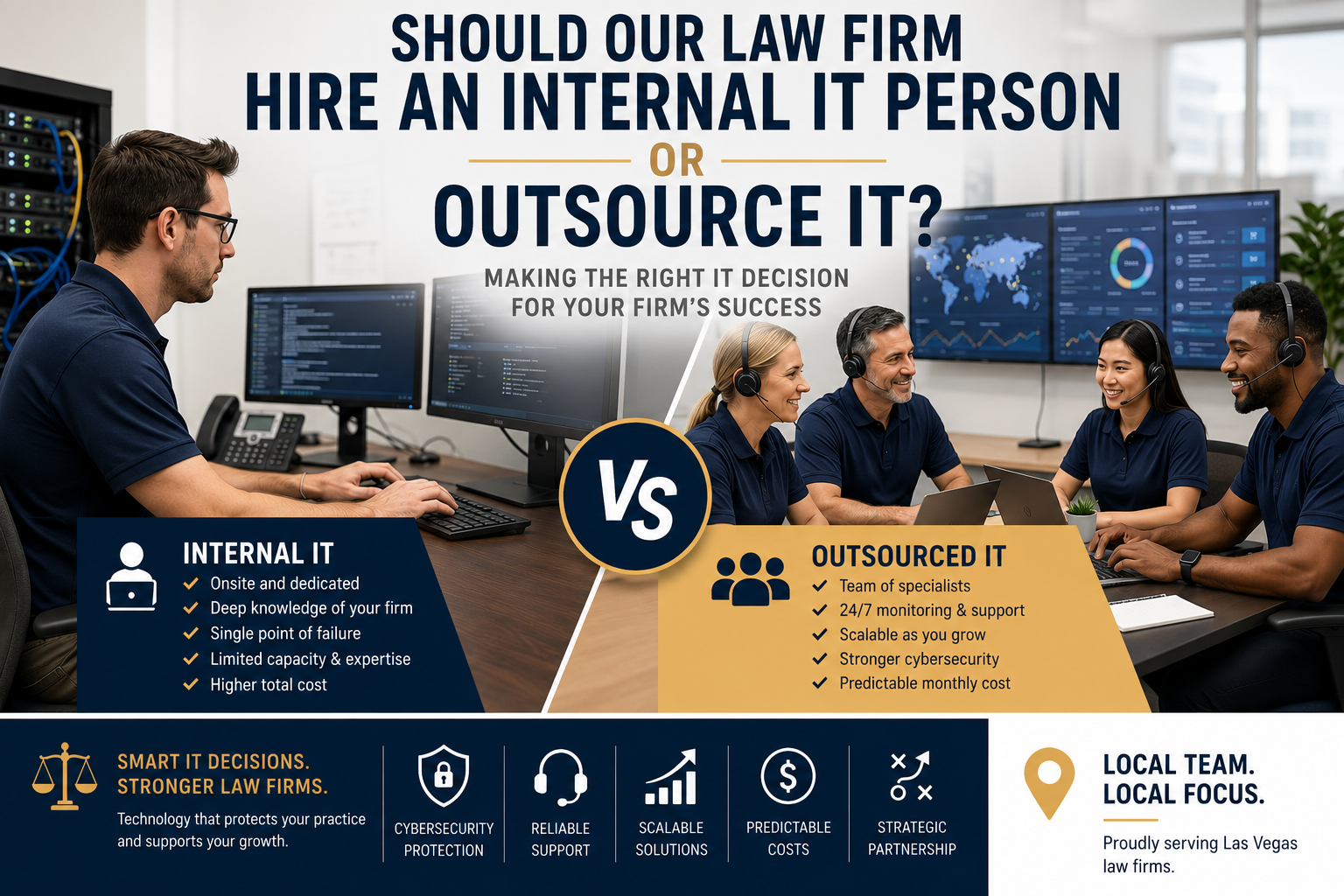
As your law firm grows, so do your technology needs.
Computers need to be replaced.
Cybersecurity becomes more important.
Employees need reliable support.
Microsoft 365 requires ongoing management.
Clients expect their confidential information to remain protected.
At some point, many managing partners and office administrators ask the same question:
Should we hire an internal IT employee, or would outsourcing IT be a better choice?
The answer depends on several factors, including the size of your firm, your technology requirements, your budget, and your long-term business goals.
This guide compares both approaches so you can determine which model best supports your practice.
Quick Answer
For most law firms with 10 to 50 employees, outsourcing IT to a managed service provider (MSP) provides broader expertise, stronger cybersecurity, predictable monthly costs, and greater scalability than hiring a single internal IT employee.
An experienced MSP typically provides access to an entire team of specialists, including help desk technicians, network engineers, cybersecurity professionals, Microsoft 365 experts, and strategic technology advisors, often for less than the total cost of hiring one full-time employee.
That doesn't mean outsourcing is always the right choice.
Larger firms with complex technology environments may benefit from an internal IT department or a hybrid model that combines in-house staff with a managed IT partner.
The key is choosing the approach that best aligns with your firm's current needs and future growth.
Why This Decision Matters
Technology is no longer just a support function for law firms.
It plays a role in nearly every aspect of your practice.
Attorneys depend on secure access to documents from the office, home, and courtroom.
Staff rely on Microsoft 365 for communication and collaboration.
Practice management software must remain available throughout the workday.
Cybersecurity has become an ongoing business priority rather than an occasional IT project.
The person or organization responsible for managing your technology has a direct impact on:
- Employee productivity
- Client experience
- Business continuity
- Cybersecurity
- Compliance efforts
- Long-term technology planning
Choosing the right IT model isn't simply about fixing computers.
It's about supporting the future of your firm.
Option 1: Hiring an Internal IT Employee
Many businesses assume that hiring someone in-house automatically provides better service.
There are certainly advantages to having an IT professional who works exclusively for your organization.
An internal employee develops a deep understanding of your firm's people, processes, and day-to-day operations.
They are physically present, can respond immediately to onsite issues, and often build strong relationships with employees.
Potential advantages include:
- Immediate onsite availability
- Familiarity with your firm's workflows
- Strong internal relationships
- Dedicated focus on your organization
- Direct communication with leadership
For some organizations, these benefits make an internal IT employee an excellent investment.
However, there are important considerations as well.
The Challenges of a One-Person IT Department
Technology has become increasingly specialized.
Today's IT environments include:
- Microsoft 365
- Cloud services
- Cybersecurity
- Networking
- Backup systems
- Identity management
- Compliance
- AI tools
- Mobile device management
- Vendor management
Expecting one person to be an expert in every area is challenging.
Even highly skilled IT professionals typically have areas of specialization.
An internal employee also has practical limitations.
They can only work so many hours in a day.
They're unavailable during vacations, sick leave, training, or personal time.
If they leave your organization, valuable institutional knowledge may leave with them.
These realities don't make internal IT a poor choice.
They simply illustrate why many growing businesses begin exploring outsourced IT as an alternative or complement to an internal employee.
Understanding the Cost of Hiring Internal IT
Salary is only one part of the total investment.
When evaluating the cost of hiring an internal IT professional, law firms should also consider:
- Payroll taxes
- Health insurance
- Retirement benefits
- Paid time off
- Continuing education
- Technical certifications
- Recruiting costs
- Employee onboarding
- Software and equipment
- Training on new technologies
For many organizations, the fully burdened annual cost of an experienced IT professional can significantly exceed the advertised salary.
At the same time, you're investing in one individual whose expertise, availability, and capacity are naturally limited.
This doesn't mean the investment isn't worthwhile.
It simply means firms should evaluate the total cost rather than focusing solely on salary.
Option 2: Outsourcing IT to a Managed Service Provider
Rather than hiring one employee, many law firms choose to partner with a managed IT provider.
Instead of relying on a single individual, the firm gains access to a team of professionals with different areas of expertise.
Depending on the provider, that team may include:
- Help desk technicians
- Network engineers
- Cybersecurity specialists
- Microsoft 365 consultants
- Cloud infrastructure experts
- Backup and disaster recovery professionals
- Strategic technology advisors
This team-based approach allows organizations to benefit from specialized knowledge without needing to hire multiple full-time employees.
For growing law firms, outsourcing IT often provides access to resources that would be difficult or cost-prohibitive to build internally.
Comparing Internal IT and Outsourced IT
Every law firm has different priorities.
Some value having someone onsite every day.
Others prioritize access to specialized expertise or predictable monthly costs.
Rather than asking which approach is universally better, ask which one better supports your firm's business objectives.
Let's compare the two models across several important areas.
Expertise
One of the biggest differences between internal IT and an outsourced IT provider is the breadth of expertise available.
An internal IT employee may have years of experience and a deep understanding of your firm's technology.
However, no one person can realistically specialize in every area of modern IT.
Today's technology environments often require expertise in:
- Cybersecurity
- Microsoft 365
- Cloud infrastructure
- Networking
- Backup and disaster recovery
- Identity and access management
- Compliance
- AI and automation
- Vendor management
A managed IT provider typically gives your organization access to specialists in each of these disciplines.
Rather than relying on one person's knowledge, your firm benefits from a collaborative team with diverse technical backgrounds.
Availability
Technology problems don't always occur during normal business hours.
An internal IT employee may be unavailable because of:
- Vacation
- Sick leave
- Training
- Personal time
- Meetings
- Large projects
When your technology support depends on one individual, those absences can affect response times.
Managed IT providers typically use a team-based support model.
If one technician is unavailable, another team member can often step in.
For many businesses, this creates greater continuity and more consistent support.
Cybersecurity
Cybersecurity has become one of the most specialized areas of information technology.
Protecting today's law firms often involves:
- Endpoint Detection and Response (EDR)
- Microsoft 365 security
- Email protection
- Vulnerability management
- Security awareness training
- Backup monitoring
- Incident response planning
- Cyber insurance readiness
Maintaining expertise across all of these areas requires continuous education and significant investment.
Many managed IT providers dedicate entire teams to cybersecurity, allowing clients to benefit from specialized knowledge that would be difficult for one employee to maintain alone.
Scalability
Technology requirements change as your firm grows.
Adding new attorneys.
Opening another office.
Hiring additional staff.
Expanding cloud services.
Supporting hybrid work.
A managed IT provider can typically scale services more quickly because additional technical resources are already available.
With an internal IT model, growth may eventually require hiring another employee or bringing in outside consultants for specialized projects.
For firms expecting continued growth, scalability is an important consideration.
Strategic Planning
One of the biggest misconceptions about IT is that it's only about solving technical problems.
The best technology decisions happen before problems occur.
A proactive technology strategy includes:
- Budget forecasting
- Hardware lifecycle planning
- Cybersecurity improvements
- Microsoft 365 optimization
- AI adoption
- Business continuity planning
Whether these conversations happen with an internal employee or a managed IT provider, they should occur regularly.
Technology planning should support your firm's long-term business objectives, not simply react to support tickets.
Which Model Costs Less?
Many organizations begin this conversation by comparing salaries.
While compensation is certainly important, it's only part of the equation.
Hiring internally means budgeting for:
- Salary
- Benefits
- Payroll taxes
- Continuing education
- Certifications
- Recruiting costs
- Equipment
- Software
- Ongoing professional development
Managed IT services typically replace many of these costs with a predictable monthly investment.
For many law firms with 10 to 50 employees, outsourced IT often provides access to a broader range of expertise at a lower overall cost than building an equivalent internal team.
That doesn't necessarily mean outsourcing is less expensive in every situation.
Larger organizations with complex technology environments may benefit from dedicated internal staff, particularly when they have the scale to support multiple IT professionals with complementary skill sets.
The Hybrid Approach
The decision isn't always either-or.
Many larger organizations use a hybrid IT model.
In this arrangement, an internal IT employee manages day-to-day business operations while a managed IT provider supplies additional expertise, monitoring, cybersecurity, and strategic guidance.
For example:
The internal IT manager may:
- Support employees
- Coordinate technology projects
- Manage vendor relationships
- Understand departmental workflows
Meanwhile, the managed IT provider may provide:
- 24/7 monitoring
- Advanced cybersecurity
- Microsoft 365 expertise
- Backup management
- Network engineering
- Strategic consulting
- Escalation support
This approach allows organizations to combine the familiarity of internal IT with the depth of knowledge available from an external technology partner.
The ANAX IT Decision Framework
Choosing between internal IT and outsourced IT shouldn't be based on a single factor like cost.
Instead, evaluate which model best supports your firm's current needs and future goals.
Ask these five questions:
- How complex is our technology environment?
Do you primarily need day-to-day support, or do you require expertise across cybersecurity, cloud services, compliance, networking, and strategic planning?
- What level of availability do we need?
Can one person adequately support your firm, or would your business benefit from a team with broader coverage?
- What expertise will we need over the next three to five years?
Consider upcoming initiatives such as cloud migrations, AI adoption, cybersecurity improvements, and business growth.
- What is our total technology budget?
Compare the fully burdened cost of hiring internally with the value provided by a managed IT partnership.
- Which model best supports our long-term business goals?
Technology should enable your firm's success, not simply maintain existing systems.
The right decision is the one that aligns with your firm's strategy, culture, and growth plans.
Which IT Model Is Right for Your Law Firm?
There's no one-size-fits-all answer.
The right choice depends on your firm's size, complexity, growth plans, and available resources.
As a general guideline:
An Internal IT Employee May Be the Right Choice If:
- Your firm has more than 75–100 employees.
- You require someone onsite throughout the day.
- You have multiple offices with complex infrastructure.
- Your technology environment requires constant hands-on administration.
- You have the budget to support an internal IT department rather than a single employee.
For larger organizations, an internal IT professional can become an invaluable member of the leadership team.
A Managed IT Provider May Be the Right Choice If:
- Your firm has between 10 and 50 employees.
- You want predictable monthly technology costs.
- Cybersecurity is becoming a higher priority.
- You need access to multiple areas of technical expertise.
- Your firm is growing.
- You want strategic technology planning in addition to day-to-day support.
For many small and mid-sized law firms, outsourcing IT provides access to capabilities that would otherwise require hiring several full-time specialists.
A Hybrid Model May Be Best If:
Some organizations don't need to choose one approach over the other.
Many successful firms combine internal IT with a managed service provider.
This allows them to maintain an internal resource who understands the business while leveraging outside specialists for:
- Advanced cybersecurity
- Microsoft 365 administration
- Network engineering
- Infrastructure projects
- Business continuity planning
- Strategic consulting
As technology becomes more specialized, hybrid IT models continue to grow in popularity.
Questions to Ask Before Making Your Decision
Before deciding whether to hire internally or outsource IT, consider discussing these questions with your leadership team.
Business Goals
- Where do we expect the firm to be in three to five years?
- Will our technology requirements become more complex?
- Are we planning to open another office or expand our staff?
Budget
- What is our annual technology budget?
- Does hiring internally provide the best long-term value?
- Are we comparing total costs rather than salary alone?
Cybersecurity
- Do we have access to the expertise needed to manage today's cybersecurity risks?
- Who is responsible for monitoring our environment?
- How will we stay current with evolving threats?
Support
- What level of support do our attorneys and staff expect?
- Do we need coverage beyond normal business hours?
- How important is rapid response during vacations or employee absences?
Strategy
- Who is helping us plan for future technology investments?
- How often do we review our technology roadmap?
- Are we making proactive decisions or simply reacting to problems?
These questions often provide more clarity than focusing on cost alone.
Why Las Vegas Law Firms Choose ANAX Business Technology
At ANAX Business Technology, we understand that every law firm has different technology needs.
For some organizations, fully outsourced IT is the right solution.
For others, a co-managed approach that supports an internal IT professional provides the greatest value.
Our role isn't to force every business into the same model.
It's to help our clients make informed technology decisions that support their business goals.
Many members of our U.S.-based team live and work in the Las Vegas valley, allowing us to provide responsive local support while building long-term relationships with the businesses we serve.
Whether we're serving as your complete IT department or working alongside your internal team, our focus remains the same:
Helping your firm operate securely, efficiently, and confidently.
Ready to Evaluate Your Firm's IT Strategy?
If you're considering hiring an internal IT employee, outsourcing your technology support, or exploring a hybrid approach, we'd be happy to help you evaluate your options.
We'll discuss your firm's goals, review your current technology environment, and explain the advantages of each model so you can make an informed decision.
Contact ANAX Business Technology to schedule a consultation:
Final Thoughts
Technology has become one of the most important investments a law firm makes.
Choosing who manages that technology deserves careful consideration.
As you evaluate your options, remember these key principles:
- There isn't a universally "right" IT model.
- The best choice depends on your firm's size, goals, and complexity.
- Total value is more important than salary or monthly cost alone.
- Cybersecurity, strategic planning, and business continuity should be part of every technology discussion.
- Your technology partner should help your firm grow, not simply solve technical problems.
Whether you build an internal IT department, partner with a managed service provider, or combine both through a hybrid model, the goal remains the same:
Use technology to support your attorneys, protect your clients, and position your firm for long-term success.