
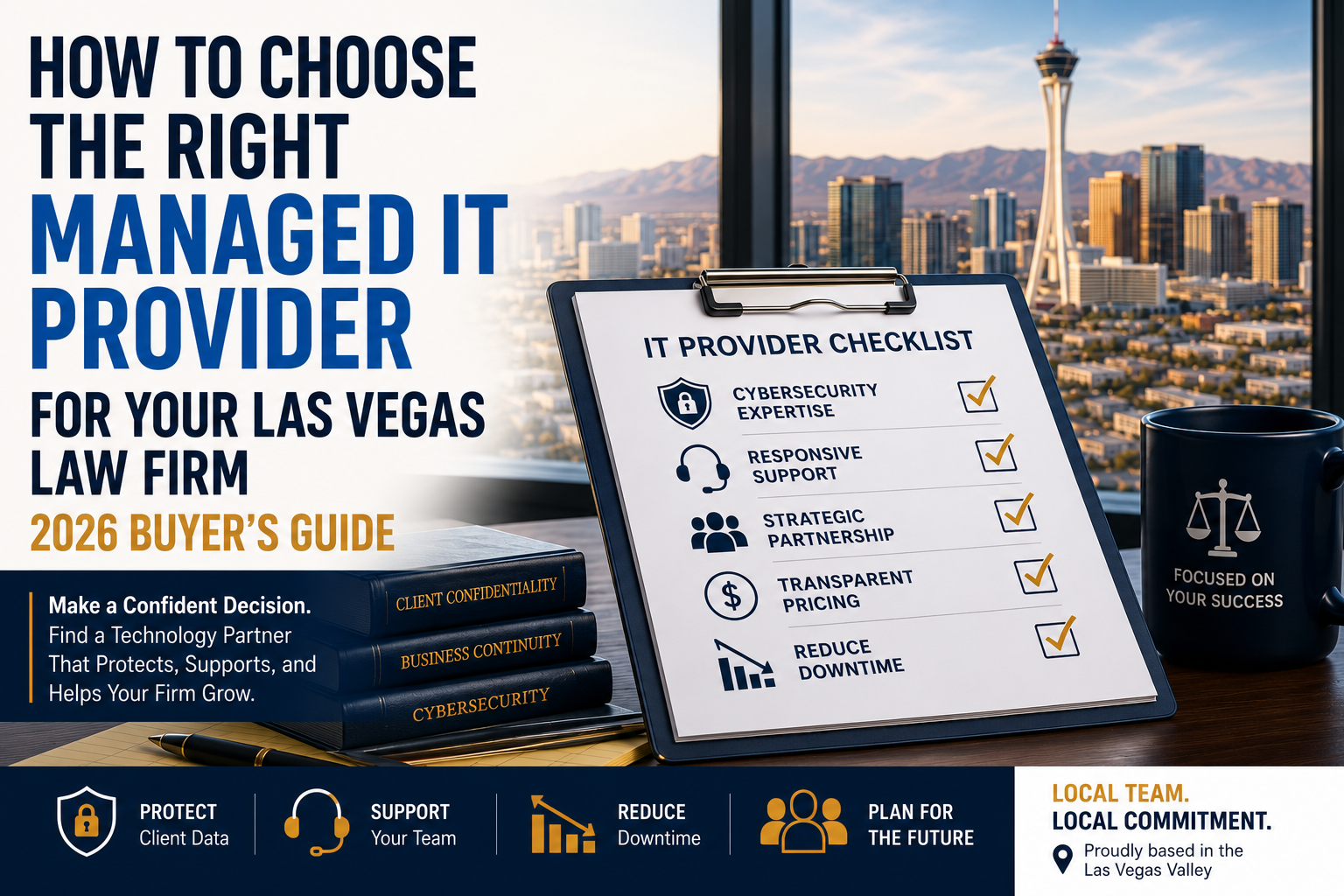
Choosing a managed IT provider is one of the most important technology decisions your law firm will make. The right technology partner can improve productivity, strengthen cybersecurity, reduce downtime, and help your firm plan for future growth. The wrong provider can lead to recurring technical issues, inconsistent support, security risks, and unexpected costs.
If you're evaluating managed IT providers in Las Vegas, this guide will walk you through the most important factors to consider so you can make a confident, informed decision.
Quick Answer
Most law firms should evaluate managed IT providers based on five key areas:
- Experience supporting professional service firms
- Cybersecurity expertise
- Responsiveness and communication
- Strategic technology planning
- Transparent pricing and clearly defined services
While monthly pricing is important, choosing a technology partner based solely on cost often leads to frustration over time. Instead, focus on finding a provider that understands your business, communicates proactively, and helps your firm make smarter technology decisions year after year.
Why Choosing the Right IT Partner Matters
Your technology touches nearly every aspect of your law firm.
Attorneys rely on secure access to client files, Microsoft 365, legal applications, email, phones, and cloud services throughout the day. Even a short technology disruption can affect billable hours, client communication, and employee productivity.
That's why choosing a managed IT provider is about much more than fixing computers when something breaks.
A trusted technology partner helps your firm:
- Protect confidential client information
- Reduce downtime
- Improve employee productivity
- Strengthen cybersecurity
- Plan future technology investments
- Budget more accurately
- Support business growth
The relationship should feel less like hiring a vendor and more like adding an experienced technology advisor to your leadership team.
Start With Your Firm's Needs
Before you begin comparing IT providers, take a step back and evaluate what your firm actually needs.
Many business owners start by searching for "the best managed IT provider in Las Vegas."
A better question is:
"What does our law firm need from a long-term technology partner?"
Every firm is different.
A 10-person practice has different technology requirements than a 50-person firm with multiple attorneys working remotely.
Consider questions such as:
- How many employees need IT support?
- Do attorneys regularly work remotely?
- Are you fully cloud-based or do you still maintain onsite servers?
- Which legal applications are essential to your daily operations?
- Do you have cybersecurity or cyber insurance requirements?
- Are you planning to hire additional employees over the next few years?
- Do you expect to open another office or expand your practice?
Understanding your own business objectives first makes it much easier to evaluate whether an IT provider is equipped to support them.
The goal isn't simply finding someone who can solve today's problems.
It's finding a technology partner that can support your firm's success over the next five to ten years.
Look Beyond Monthly Pricing
For many firms, price is one of the first questions during the evaluation process.
That's understandable.
Technology is a significant business investment, and every firm wants to make sure it's receiving value.
However, comparing providers based only on the monthly cost per user can be misleading.
Managed IT service agreements often include very different levels of support, cybersecurity, strategic planning, and onsite service.
For law firms in Las Vegas, managed IT services typically range from $150 to $300 per user, per month, depending on the services included, your firm's technology environment, and your cybersecurity requirements.
If you haven't already, we recommend reading our complete guide:
How Much Do Managed IT Services Cost for Law Firms in Las Vegas?
As you compare proposals, ask questions such as:
- What's included in the monthly agreement?
- Are onsite visits covered?
- Are cybersecurity tools included or billed separately?
- Does the agreement include Microsoft 365 administration?
- Are technology planning meetings included?
- Are projects billed separately?
- Are there additional fees for onboarding new employees?
Two proposals with similar monthly pricing can deliver very different levels of service.
Rather than asking, "Which provider is the cheapest?"
Ask:
"Which provider delivers the greatest long-term value for our firm?"
Evaluate Their Cybersecurity Expertise
Cybersecurity has become one of the most important responsibilities of any managed IT provider.
Law firms routinely manage confidential client communications, financial records, contracts, litigation documents, intellectual property, and other sensitive information that make them attractive targets for cybercriminals.
Your technology partner should view cybersecurity as a continuous process, not an optional add-on.
During the evaluation process, ask prospective providers about their approach to:
- Multi-Factor Authentication (MFA)
- Microsoft 365 security
- Endpoint detection and response (EDR)
- Email security
- Backup monitoring and testing
- Security awareness training
- Vulnerability management
- Incident response planning
- Cyber insurance requirements
Pay attention to how they answer.
A knowledgeable provider should explain these topics in clear, understandable language without relying on technical jargon or fear-based sales tactics.
The best technology partners help clients understand risk, prioritize improvements, and build a cybersecurity strategy that evolves as threats change.
Evaluate How They Communicate
Technology expertise is important.
Communication is equally important.
Even the most technically skilled IT provider can become frustrating to work with if they don't communicate clearly, respond promptly, or explain recommendations in a way your team understands.
As you evaluate potential technology partners, pay attention to how they communicate during the sales process.
Ask yourself:
- Do they respond promptly?
- Do they answer your questions directly?
- Do they explain technical concepts in plain English?
- Do they listen before recommending solutions?
- Do they take time to understand your business?
The experience you have before signing an agreement is often a good indicator of what the ongoing relationship will feel like.
A good technology partner shouldn't leave you wondering what's happening or when you'll hear back.
Ask About Strategic Planning
Many managed IT providers focus almost exclusively on day-to-day support.
While responsive help desk services are important, they're only one part of a successful technology partnership.
As your law firm grows, technology decisions become more strategic.
Questions begin to shift from:
"Can you fix my computer?"
to
"How should we budget for technology over the next three years?"
"When should we replace our computers?"
"Should we move additional workloads to the cloud?"
"How can we better protect confidential client information?"
A proactive technology partner should help answer those questions before they become urgent.
Ask prospective providers whether they include:
- Quarterly or annual business reviews
- Technology budgeting assistance
- Hardware lifecycle planning
- Cybersecurity roadmaps
- Microsoft 365 optimization
- Business continuity planning
- Long-term technology recommendations
Technology shouldn't simply support today's operations.
It should help position your firm for tomorrow's opportunities.
Consider the Value of Local Support
Technology has made remote support faster and more efficient than ever.
Many issues can be resolved without anyone stepping foot in your office.
That said, there are still situations where having a local technology partner provides significant value.
When evaluating managed IT providers, ask questions such as:
- Can you provide onsite support when needed?
- How quickly can someone be at our office?
- Will we work with the same technicians over time?
- Do you understand the local business community?
At ANAX Business Technology, most of our U.S.-based team members live and work in the Las Vegas valley.
That allows us to build long-term relationships with our clients while providing responsive local support when it's needed most.
Whether we're assisting with a new office setup, replacing critical equipment, or meeting to discuss your technology roadmap, being local helps us better understand the businesses we serve.
For many law firms, knowing there's a trusted technology partner nearby provides an added level of confidence.
Ask for Client References
Every IT provider will have testimonials on their website.
Those are helpful, but they shouldn't be your only source of information.
Don't hesitate to ask for client references.
Speaking directly with an existing customer can provide valuable insight into what it's actually like to work with a provider over the long term.
Consider asking references questions like:
- How long have you worked together?
- How responsive is their support team?
- Do they communicate proactively?
- Have they helped improve your cybersecurity?
- Would you hire them again?
Whenever possible, ask to speak with organizations that are similar to yours.
For law firms, hearing from another professional services organization can be especially valuable because they often face similar technology and security challenges.
Ask About Their Onboarding Process
One of the clearest signs of an experienced managed IT provider is having a documented onboarding process.
Successful transitions don't happen by accident.
They happen because there's a proven plan.
Ask prospective providers to explain:
- What happens during the first week?
- What information do they need from your current IT provider?
- How do they document your environment?
- How do they minimize downtime?
- How do they communicate with employees?
- What happens after the transition is complete?
If you've already read our guide on switching managed IT providers without downtime, you'll recognize that a structured onboarding process is one of the biggest indicators of a mature technology partner.
Learn more about what to expect during an IT transition:
How Do You Switch Managed IT Providers Without Downtime? A Guide for Las Vegas Law Firms
A provider that can clearly explain its onboarding process is often a provider that's completed many successful transitions before.
Red Flags to Watch For
Choosing the right technology partner isn't just about identifying strengths.
It's also about recognizing warning signs before signing an agreement.
Here are a few red flags worth paying attention to.
Pricing That Seems Too Good to Be True
If one proposal is dramatically less expensive than the others, ask why.
Lower pricing isn't necessarily a problem, but it's important to understand what's included and what isn't.
Questions to ask include:
- Are cybersecurity services included?
- Are onsite visits extra?
- Are there limits on support?
A lower monthly fee can sometimes result in higher overall costs if essential services are billed separately.
Vague Answers
If every question is answered with:
"It depends."
or
"We'll figure that out later."
keep asking questions.
A reputable technology partner should be able to clearly explain:
- Their onboarding process
- Support expectations
- Response times
- Security approach
- Communication process
Transparency builds confidence.
No Strategic Conversations
If every discussion revolves around fixing computers and closing support tickets, that's a warning sign.
Technology should support your firm's long-term success.
Look for a provider that wants to understand your goals, growth plans, and future technology needs.
No Clear Cybersecurity Strategy
Cybersecurity shouldn't be treated as an optional upgrade.
Ask how the provider approaches:
- Risk assessments
- Security awareness training
- Microsoft 365 protection
- Backup testing
- Incident response
- Compliance support
If cybersecurity isn't part of the conversation, it probably won't become a priority after you become a client.
Poor Communication During the Sales Process
Pay attention to your experience before you sign.
If emails go unanswered, meetings are difficult to schedule, or proposals take weeks to arrive, consider whether that experience is likely to improve after you're a client.
The sales process often sets the tone for the relationship that follows.
The ANAX Buyer's Checklist
As you compare managed IT providers, use this checklist to help guide your decision.
A strong technology partner should be able to confidently answer "yes" to most or all of these questions.
Business Alignment
☐ Do they understand the needs of our law firm?
☐ Do they ask about our business goals before recommending solutions?
☐ Do they provide long-term technology planning?
Support
☐ What level / how much help desk support included?
☐ Is onsite support available when needed?
☐ Are response expectations clearly explained?
Cybersecurity
☐ Is cybersecurity included in the monthly agreement?
☐ Do they provide Microsoft 365 security guidance?
☐ Do they regularly review backups and security controls?
Communication
☐ Will we have regular business reviews?
☐ Do they communicate clearly and proactively?
☐ Will we work with familiar technicians over time?
Partnership
☐ Do they feel like a long-term advisor rather than just another vendor?
If you can confidently check every box, you've likely found a technology partner that's well-positioned to support your firm for years to come.
Frequently Asked Questions
How many managed IT providers should we interview?
There's no single right number, but most law firms benefit from speaking with three providers before making a decision.
Interviewing multiple companies allows you to compare:
- Services included
- Communication style
- Cybersecurity approach
- Pricing
- Strategic planning
- Overall fit
Rather than focusing solely on cost, pay attention to which provider takes the time to understand your firm's goals and explain their recommendations clearly.
Should we choose a local or national IT provider?
Both can provide quality IT support, but there are advantages to working with a local technology partner.
A provider based in the Las Vegas area can often offer:
- Faster onsite support
- Face-to-face planning meetings
- Familiarity with the local business community
- Long-term relationships with your team
Many day-to-day support requests can be handled remotely, but having local experts available when you need them can provide additional peace of mind.
Is the lowest-priced managed IT provider usually the best value?
Not necessarily.
A lower monthly price may mean fewer included services, limited cybersecurity protections, or additional charges for onsite visits and projects.
Instead of asking:
"Who charges the least?"
Ask:
"Which provider gives our firm the greatest long-term value?"
A slightly higher monthly investment often results in fewer technology problems, stronger security, and more predictable budgeting over time.
How important is cybersecurity when choosing an IT provider?
Cybersecurity should be one of the most important factors in your decision.
Law firms manage confidential client information, financial records, legal documents, and other sensitive data that require strong protection.
Your technology partner should take a proactive approach to cybersecurity by helping you reduce risk, educate employees, and continuously improve your security posture.
Should the IT provider have experience working with law firms?
Industry experience can be valuable.
A provider that regularly supports legal professionals is more likely to understand:
- Microsoft 365 for legal workflows
- Document management systems
- Confidentiality requirements
- Secure remote access
- Business continuity planning
- The importance of minimizing downtime during business hours
While every firm's needs are unique, experience with professional services organizations can help reduce the learning curve.
What should happen after we sign the agreement?
Signing a managed IT agreement shouldn't be the end of the conversation.
It should be the beginning of a long-term partnership.
A quality technology partner should guide you through a structured onboarding process, establish clear communication, review your technology environment, and begin identifying opportunities to improve security, productivity, and long-term planning.
If you'd like to learn more about what that process looks like, read our guide:
How Do You Switch Managed IT Providers Without Downtime? A Guide for Las Vegas Law Firms
Choosing the Right Technology Partner Is About More Than IT
When business owners begin evaluating managed IT providers, they often focus on technical capabilities.
Can they fix computers?
Can they support Microsoft 365?
Can they help with cybersecurity?
Those questions are important.
But over time, something else becomes even more valuable.
Trust.
The best technology partnerships are built on open communication, thoughtful planning, and a shared commitment to helping your business succeed.
You shouldn't have to wonder whether support requests will be answered, whether cybersecurity is being maintained, or whether your technology is keeping pace with your firm's growth.
Instead, you should feel confident that someone is helping you make informed technology decisions before problems arise.
That's the difference between hiring an IT company and partnering with a trusted technology advisor.
Why Las Vegas Law Firms Choose ANAX Business Technology
At ANAX Business Technology, we believe managed IT services should go beyond troubleshooting technology problems.
Our goal is to help law firms use technology to improve productivity, strengthen cybersecurity, and support long-term business growth.
Most of our U.S.-based team members live and work in the Las Vegas valley, allowing us to build lasting relationships with the businesses we serve while providing responsive local support when it's needed.
Whether we're helping a new client transition from another provider, developing a technology roadmap, or responding to a support request, we believe every interaction should reflect the same values:
- Clear communication
- Proactive planning
- Responsive service
- Long-term partnership
Technology changes quickly.
Having a trusted partner to help you navigate those changes can make all the difference.
Ready to Find the Right Technology Partner?
Choosing a managed IT provider is an important decision, and it shouldn't feel rushed.
If you're evaluating your options and would like an experienced perspective, we'd be happy to have a conversation.
We'll learn about your business, answer your questions, discuss your goals, and explain what working with ANAX Business Technology looks like. Whether you're ready to switch providers now or simply gathering information for the future, our team is here to help.
Schedule a consultation with ANAX Business Technology:
Final Thoughts
The right managed IT provider won't simply keep your computers running.
They'll help your law firm make better technology decisions, reduce risk, improve productivity, and prepare for future growth.
As you evaluate your options, remember these key principles:
- Start with your firm's business goals.
- Look beyond monthly pricing.
- Evaluate cybersecurity expertise.
- Pay attention to communication.
- Choose a provider that offers strategic guidance, not just technical support.
- Look for a long-term technology partner, not just a help desk.
Technology will continue to evolve.
The value of a trusted partnership won't.